United Kingdom Parliamentarians
Call On President Kabbah
Parliamentarians
from the United Kingdom, who are currently visiting
the country, today called on the President,
Alhaji Dr Ahmad Tejan Kabbah, to brief him about
the purpose of their visit and to seek his views
on certain issues affecting the country.
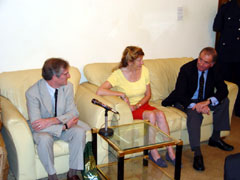
Labour Party MP, Hon Win Griffiths,
who spoke on behalf of the group, said they
were in Sierra Leone at the invitation of the
Sierra Leone Commonwealth Parliamentary Group
to see how the Sierra Leone Parliament was coping
with democracy as well as the tremendous problems
that arose from ten years of war.
He said their purpose of meeting
the President was to learn about the country's
problems and to see h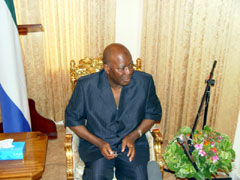 ow
the U.K, the EU, UN and others could support
the efforts of government in rebuilding the
country. Mr Griffiths expressed the hope that
the type of information they would obtain during
their stay in the country would help them make
representations to their governments and also
get the private sector to be involved in Sierra
Leone.
ow
the U.K, the EU, UN and others could support
the efforts of government in rebuilding the
country. Mr Griffiths expressed the hope that
the type of information they would obtain during
their stay in the country would help them make
representations to their governments and also
get the private sector to be involved in Sierra
Leone.
"We are pleased to see that
there are no more guns in the country and that
the atmosphere is now a bit more relaxed,"
Hon Griffiths said. Welcoming the move taken
by government to conduct local government elections,
he said they would also be willing to offer
whatever help they could to facilitate the process.
President Kabbah thanked the group
and expressed gratitude to the people of the
United Kingdom for showing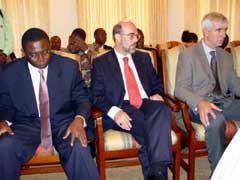 a lot of interest in the welfare of Sierra Leoneans
and their sustained interest in the country's
development. He praised, in particular, membersof
the British House of Lords and Parliament for
supporting Her Majesty's Government's policies
on Sierra Leone.
a lot of interest in the welfare of Sierra Leoneans
and their sustained interest in the country's
development. He praised, in particular, membersof
the British House of Lords and Parliament for
supporting Her Majesty's Government's policies
on Sierra Leone.
He observed that Sierra Leone
had over the years not been able to build sufficient
wealth due to bad governance and instability
to maintain the country and commended Her Majesty's
government for its support in helping to rebuild
the country's damaged infrastructure.
President Kabbah mentioned that
situations in post conflict countries like Sierra
Leone could generally be difficult as it takes
time for people to decide on investing in such
countries until they were able to guarantee
a certain level of stability.
He
said that not only was the country bankrupt
when he assumed office in 1996, but there had
also been a massive plunder of the economy and
mismanagement of State authority and institutions
by previous governments. President Kabbah therefore
opined that there should be a relaxation of
conditions when considering extending aid and
assistance to such countries.
He recalled that since independence
there had not been any move to restructure and
redesign government institutions. Therefore,
he said apart from rebuilding the country's
infrastructure, steps were being taken to rebuild
and re-engineer government institutions to provide
the necessary structures for the country's socio-economic
development.
He
said government was aware of the potential for
donor fatigue as the demand for humanitarian
support from the international community keeps
increasing as more and more developing countries
get involved in conflicts situations. The President
said he had been talking to Sierra Leoneans
about the need for them to work harder and to
build up sufficient wealth to service social
and other needs. He expressed the hope that
more people from outside who have the resources
would be encouraged to come and invest in the
country either as sole shareholders in private
companies or in par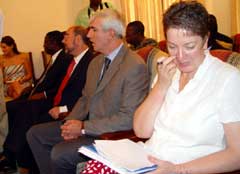 tnerships
with Sierra Leoneans. In this connection President
Kabbah went on to highlight a range of possible
areas for investment, including minerals mining
such as gold, alluvial and kimberlite diamonds,
rutile, bauxite as well as the oil sector. He
said that the country's agricultural potentials
were enormous and looked forward to investment
in that sector.
tnerships
with Sierra Leoneans. In this connection President
Kabbah went on to highlight a range of possible
areas for investment, including minerals mining
such as gold, alluvial and kimberlite diamonds,
rutile, bauxite as well as the oil sector. He
said that the country's agricultural potentials
were enormous and looked forward to investment
in that sector.
Touching on the area of security,
the Head of State commended the British government
again for its support in reorganising the country's
security and armed forces by training and equipping
both the military and police. He added that
the British-led IMATT were doing a fantastic
job, saying that if proper logistics were provided
the army and police would be adequately placed
to take over the security of the country as
and when UNAMSIL troops are scaled down as part
of its draw-down plan. He therefore appealed
for continued co-operation and support in that
area.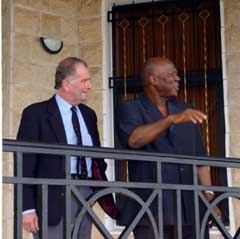
On the Sierra Leone Parliament,
President Kabbah stated that parliamentarians
were very enthusiastic about their job, but
observed that they lacked a solid information
base and the necessary logistics to enable them
respond in a substantive way to the proposals
coming from the Executive for legislation and
also to carry out their work effectively.
He said for government tobe able
to meet with all these demands it would have
to raise taxes which would no doubt result in
overburdening the people. He said increasing
taxes in order to raise government's revenue
in a post conflict situation like Sierra Leone's
could be counterproductive.
He therefore suggested that institutional
support to Parliament through bilateral assistance
could be one way in which additional needs of
that body could be addressed instead of resorting
to imposing more taxes on a citizenry that is
just emerging from war. The President thanked
the group again for honouring him with their
visit and said that he looked forward to more
co-oiperation between the group and their counterparts
in Sierra Leone.
-End-


