Truth
and Reconciliation Commission Presents Report
By Marian Samu
Tuesday,
October 5 - The Truth and Reconciliation
Commission (TRC), one of the institutions mandated
to be set up by the Lome Peace Agreement, presented
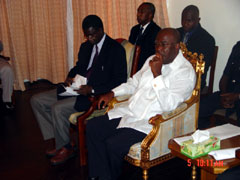
its final report to President Ahmad Tejan Kabbah
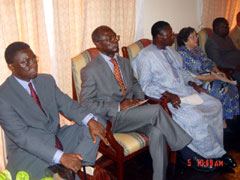
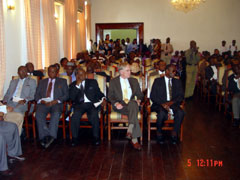
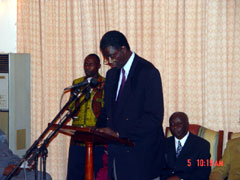
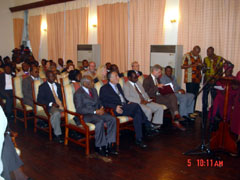
at a well-attended and impressive ceremony held
at State House, Freetown, on October 5, 2004.
The
report, accompanied by a Child-friendly version,
was presented in the presence of a galaxy of
dignitaries including representatives of the
United Nations system, the diplomatic community,
International donor organizations, Non-governmental
organizations, and representatives of Civil
Society and school children.
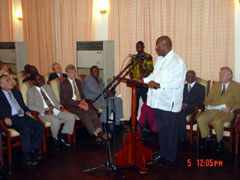
Delivering
the message from the United Nations High Commissioner
for Human Rights, Mr. Jose Dougan Beaca said
that the occasion of the presentation of the
report represented an important milestone in
the recent history of Sierra Leone and in a
remarkable way underscored the fruitful collaboration
between the Government and people of Sierra
Leone, the Office of the High Commissioner for
Human Rights and the United Nations system as
a whole.
The
High Commissioner noted that her office's involvement
in the effort led by the people of Sierra Leone
to rebuild their country on the foundations
of the rule of law, democracy and respect for
human rights, started with the adoption of the
Sierra Leone Human Rights Manifesto in June
1999, during the visit of the then High Commissioner,
Ms. Mary Robinson.
The
report, she also noted, contains the accounts
of the people of Sierra Leone during a trying
period, characterized by the most grievous violations
of human rights, and that it must be seen as
part of a universal effort to prevent impunity
for violations of human rights and humanitarian
law in conflict situations, and a modest but
important attempt to respond to the quest for
justice by thousands of innocent victims of
the war.
She
saluted the courage of the many women, men and
children who came forward to tell their stories
in public hearings as well as the humility and
decency of those who came to express their profound
regret for the role they played during those
dark days. She expressed hope that the recommendations
will be implemented as required by the TRC Act
(2000), which prescribed legal, political and/or
administrative reforms, and that Government
must do all in its power to implement them in
accordance with section 17 of the act.
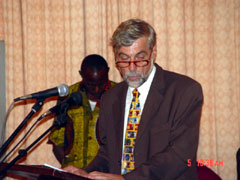
The
Special Representative of the Secretary-General,
Ambassador Daudi Mwakawago, in his statement
described the report and its recommendations
as an important milestone in our collective
effort to unearth past injustices and to recover
the truth about the conflict in Sierra Leone.
The testimony of thousands of witnesses who
were courageous enough to come forward to share
their respective stories, he said, is a vital
component of transitional justice in Sierra
Leone.
Ambassador
Mwakawago stated that as a civil war or conflict
comes to and end, many governments are confronted
with a series of fundamental questions of legal,
political and even psychological nature, and
the answers to these questions might invariably
determine the future stability of the country.
In Sierra Leone, he said, a two-prong complementary
approach was adopted in dealing with these questions:
Justice and accountability through a Special
Court for those who bear the greatest responsibility
for the acts and atrocities committed during
the war; and a Truth and Reconciliation Commission
to create an impartial historical record of
violations and abuses committed during the war,
with the view to address the question of impurity;
respond to the needs of victims of the conflict,
and promote healing and national reconciliation.
He
said that UNAMSIL is proud to have been part
of the process as it assisted in the substantive
work of the Commission by providing technical
assistance in the area of human rights, and
served as a conduit between the Commission and
the Office of the High Commissioner for Human
Rights in Geneva.
Ambassador
Mwakawago, however, noted that the report would
not have come into being without the selfless
sacrifices made by the witnesses and the tireless
efforts by all members of the Commission. On
behalf of the Secretary-General of the United
Nations, Mr. Kofi Annan, and the entire United
Nation family, he expressed thanks and appreciation
to the Commissioners and staff for the fulfillment
of their mandate and to the thousands of witnesses
who related their stories, many of them in tears,
pain and agony.
No
society, Mr. Mwakawago maintained, can build
a democratic future on a foundation of a forgotten,
denied or incomplete history. The future, he
said, depends on the past, and if Sierra Leone
is to move forward as a nation, it is essential
that she confronts the legacy of her past, regardless
of how painful, ugly and horrific it is. He
urged Sierra Leoneans to learn from their mistakes
and vow never again to repeat them, and that
it is only by doing so that the nation and its
people can put the past behind them and move
forward.
Mr.
Mwakawago applauded the work of the TRC, as
a significant contribution to the peace process
and stability of this country, and to the process
of healing and reconciliation, because in the
absence of such a legacy, he said, there will
be no solid foundation on which to rebuild this
great country.
He
appealed to all Sierra Leoneans to let this
report be a symbol of their commitment to never
again engage in those acts that brought this
country to its knees through a civil war and
to let the report be a symbol of their commitment
to move forward in the spirit of peace, national
unity and reconciliation.
UNAMSIL,
he said, will continue in its work of laying
the foundations for peace and stability in the
spirit and letter of the Security Council resolution
1562 (2004), which accords primacy to important
issues relating to good governance, justice
and the rule of law in addition to bolstering
the security sector.
A
representative of the donor community, Mr. Jean
Tunacliff from the European Commission expressed
gratitude to all those countries that supported
the work of the TRC, as the occasion would not
have been possible without funds from those
donors.
A
representative of the Truth and Reconciliation
Working Group, a coalition of civil society
groups, Mr. John Caulker, appealed to government
for an effective dissemination of the report,
and for the setting up of the war victim's reparation
fund. He noted the importance of the rights
of victims to truth and justice and encouraged
both victims and perpetrators to be involved
in the reconciliation process.
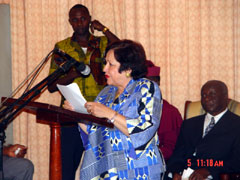
The
UNICEF Regional Director for West and Central
Africa, Dr. Rima Salah, extolled the TRC for
the production of the child-friendly version
of the report, adding that this was the first
time in the world that a children's version
of a Truth and Reconciliation report has been
prepared. She said it is important for the children
to better understand the things that happened
and recommended that young adults be given a
stronger voice to participate in governance
so that they may not be frustrated.
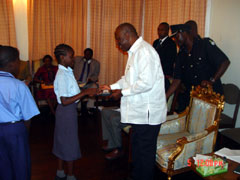
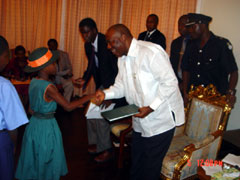
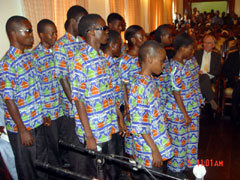
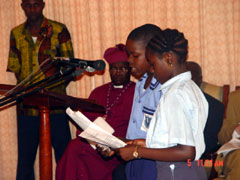
Representatives
of children in their statements expressed their
pleasure for consulting with them and involving
them in the development of the Child-friendly
version of the report. They called on government
to ensure the proper implementation of the recommendations
of the report and recommended that government
put an end to the recruitment of children by
armed groups, eliminate child labour and sexual
exploitation and support children whether victims
or perpetrators. They requested that government
support family reintegration for those children
that were separated from their families by the
war and render support to child-friendly associations.
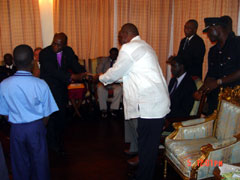
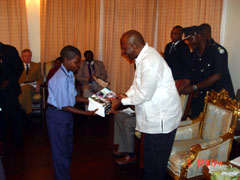
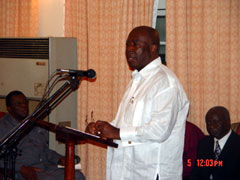
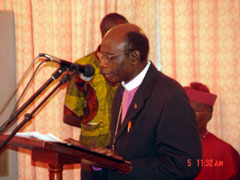
Presenting
the report to President Kabbah, the Chairman
of the Truth and Reconciliation Commission,
Bishop J.C. Humper, amongst the many recommendations
embodied in the report, asked that January 18
be declared a National Reconciliation Day, as
it was on the 18th January 2002 that President
Kabbah formally declared the end of the war,
when he pronounced at Lungi that "the war
don done", meaning in krio that the war
was over.
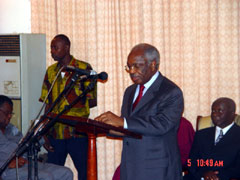
Receiving
the Report from the TRC Chairman, the President,
Alhaji Dr. Ahmad Tejan Kabbah, said that by
listening to the presentations of the representatives
of children, he was relieved from any doubt
he had had about the future of Sierra Leone,
since the children manifested by their brilliant
performances that, indeed, there was hope for
a bright future for the country. He confessed
that he could now return to his maker, confident
that all was not lost and that Sierra Leone's
glorious future was only a matter of time and
determination.
The
President described the occasion as another
significant milestone in the history of the
country and noted that the Report of the Truth
and Reconciliation Commission was not just another
Report, but a sacred document that embodied
the collective reflections on the ten-year destructive
conflict which he referred to as the greatest
tragedy the country has ever known. He thanked
the Almighty God that the nation survived this
tragedy, adding that it was the courage and
resilience of the people that enabled Sierra
Leoneans to accomplish the arduous task of not
only putting the war behind them, but of documenting
the sad and painful experiences of the war.
He
said that while Sierra Leoneans should be proud
to acknowledge that their nation survived the
war intact, it is obligatory on them to always
remember with deep sorrow that this came at
the cost of the lives of many of their compatriots
and citizens of friendly countries, in addition
to the severe physical and emotional damage
inflicted on many others. On behalf of all the
citizens of the country, he paid homage to the
illustrious heroes of the war and asked that
special prayers be offered for the souls of
those who lost their lives.
The
event, President Kabbah said, marked a major
step in the reconciliation of Sierra Leone society
through the transitional justice process, stating
that the process which addresses the issues
of guilt, contrition and forgiveness was critical
for the restoration of trust and harmony among
the people, after the horrible and divisible
experiences of the war.
The President paid special tributes to the Commission
for having carried out their mandate so thoroughly
under very difficult circumstances, the Office
of the High Commissioner for Human Rights, particularly
Mary Robinson, the UNDP, UNAMSIL, UNICEF, the
Truth and Reconciliation Commission Working
Group, and Civil Society organizations. He also
expressed sincere gratitude to the Donor community
for the support rendered to the Commission.
President
Kabbah also noted that the importance of the
Truth and Reconciliation Commission Report was
that it would remind the people of Sierra Leone
about where things went wrong so that they can
learn appropriate lessons as to how to ensure
that the hard-earned peace is sustained and
conflicts are avoided, adding that he has no
doubt that the Report will contain a clear statement
that bad governance over a long period is an
important contributory factor to the conflict.
The present Government, he said, realized this
fact from the moment it took over the administration
of the country in 1996 and for this reason,
it introduced measures to eliminate the worst
and obvious elements of bad governance. The
emphasis since then, he said, has been to ensure
that such matters like transparency in public
affairs and accountability by public officials
and in Government are maintained.
The
President said he believed that the report would
have found out that the lack of patriotism,
selfishness and greed by a good number of our
people facilitated the destruction of our nation,
and it is for this reason that his Government
is constantly urging the people to be public-spirited,
to know and enjoy their legal and constitutional
rights, but do so without trampling on the rights
of others as well. This, he maintained, is in
accordance with Section 15 of the 1991 Constitution
of Sierra Leone and said that it will promote
harmony and further help to sustain the peace
in our communities.
President
Kabbah emphasized that Government will not relent
to call on the perpetrators to continue to show
remorse and the victims to show forgiveness,
as this will be the greatest assurance for healing
and reconciliation to take place effectively,
adding that we can only build a better future
if we all learn to forgive others for the pains
inflicted on us during the conflict.
He
assured all that Government is committed to
take the Report and its recommendations seriously
and that it will study them diligently and state
its position soon. He urged the entire international
community to work together with, and assist
Government in the implementation of the Commission's
recommendations. "There can be no better
opportunity for such cooperation and international
assistance to this country", he concluded.
-End-