|
THE
UNIVERSITY OF SIERRA LEONE
ADDRESS BY THE CHANCELLOR
HIS EXCELLENCY ALHAJI DR AHMAD TEJAN KABBAH
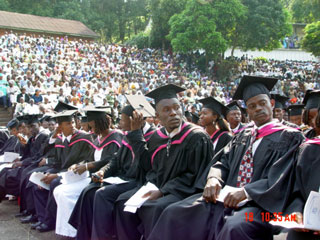
AT THE 2004 UNIVERSITY CONGREGATION
ADJAI
CROWTHER AMPHITHEATRE
MOUNT AUREOL, FREETOWN
SATURDAY 18TH DECEMBER 2004
Honourable
Vice President
Mr Speaker of Parliament
Honourable Chief Justice
Deputy Chair of University Court
Vice Chancellor
Excellencies
Distinguished Guests
Officers, Faculty and Staff
Graduands and Students
Ladies and Gentlemen:
Let
us continue the tradition that we began in this
amphitheatre three years ago. So, as a prelude
to my annual University address, I now invite
the entire Congregation to join me in giving the
new graduands a special round of applause.
This
gesture is a public recognition of their achievement.
As Chancellor I congratulate you. I commend you
for your perseverance against all the constraints
that are associated with the pursuit of higher
education in a developing country.
Today,
you have every reason to be overwhelmed by the
pomp and pageantry of this ceremony. Soon you
will be displaying with pride your degree, diploma
or certificate as testimonials of your achievement.
However, I entreat you not to forget all those
who were instrumental in making this occasion
possible. First - your parents and guardians,
your extended families and benefactors. We salute
you all. We pray that the seeds you have sown,
the investments you have made in time and money,
as well as in nurturing these graduands will yield
fruits abundantly.
Secondly,
do not forget your professors, lecturers, tutors
and other faculty members. They too made sacrifices
to ensure that you achieve your objectives. They
too enhanced your capacity to contribute to the
human resource development of the country. Allow
me Mr Vice Chancellor to commend you and members
of the faculties and staff of the constituent
colleges and institutes of the University for
your dedication, and distinguished service to
the nation. Often, perhaps too often, we underestimate
the contribution that teachers and other educators
make to our personal careers. We also forget the
crucial role they play in national development.
I should like to take this opportunity to reassure
you all that in my capacities as Chancellor and
also as Head of State I will continue to help
create better conditions in which you can continue
to perform your invaluable services. God willing,
we will be able to create greener pastures right
here in Sierra Leone for faculty and staff.
Every
University Congregation is an occasion for the
conferment of degrees, diplomas and certificates.
It is also an occasion to highlight some of the
challenges that the recipients of these awards
will face when they leave this ceremony. The congregation
also provides another opportunity for us to outline
the course that the University should chart for
those who will enter these gates in the next few
years.
How,
for example do we see higher education in the
next three years? How do we intend to respond
to the needs of those who are already knocking
at the door of this University or indeed the needs
of those who graduate from the University in terms
of employment? And how do we ensure that the services
of these graduates benefit the nation, particularly
the less privileged members of our society.
Mr
Vice Chancellor, I suggest that the answers are
closely connected with the theme of my address
to this Congregation this afternoon, namely accessibility
to higher education. The theme of this year's
congregation could not have been more relevant
and appropriate. Indeed, access to higher education
presupposes that the required numbers and foundation
are laid at the school stratum.
The
last six years have witnessed the largest single
investment by government and its development partners
in the school system. Every Sierra Leonean should
therefore take pride in the fact that the investment
is paying dividend in the increased access and
standards at all layers of the school system.
The
300% increase in school enrolment over this period
has necessitated an expansion of our higher education
sector. The expansion will no doubt accommodate
the great numbers that are currently being produced
by our schools. The physical and other restrictions
that hitherto existed in higher education, excluding
large segments of our school leaving population,
will now be would a thing of the past.
In
more general terms, accessibility involves pragmatic
decentralization, regional balance, equity and
diversity. We have to respond to the needs of
all individuals who have a right to be accorded
equal access to and opportunities for higher education.
In this regard, we shall, as a matter of priority,
accelerate the process that is already underway
to implement the principal recommendations of
the 1996 Technical Restructuring Committee on
tertiary education set up by the Ministry of Education,
Science and Technology.
The
restructuring of the Milton Margai Teachers College
into the Milton Margai College of Education and
Technology, the establishment of the Eastern Polytechnic
and the commencement of operation of the Northern
Polytechnic are clear examples of the implementation
process.
You
will recall that another major recommendation
of the Committee is the expansion of the Sierra
Leone University system into at least two autonomous
public universities. I am pleased to inform you
that the University Act 2004 has now been enacted
by Parliament. This will lead to the creation
of the reconstituted University of Sierra Leone,
and Njala University as an autonomous entity,
as well as open up the possibility for the establishment
of private universities and other institutions
of higher learning. Each University will have
its own Court, Senate and Faculties.
Distinguished
Ladies and Gentlemen, the current student enrolment
in the University of Sierra Leone is under 6000.
With this number we will not be able to progress
from an under-developed to a rapidly developing
country. The number exposed to tertiary education
should therefore be much higher. It is envisaged
that in three years' time the student body of
each of the Universities would range from 12,000
to 15,000. This means that under the new system
thousands of young people who are eligible would
gain access to higher education within Sierra
Leone on an equal basis. The envisaged expenditure
will be immense. Government will therefore require
the services of graduates in our rural communities
to address the current inequalities in the distribution
of these services, as a pathway to equitable development
and national cohesion.
Mr
Vice Chancellor, members of the 2004 University
Congregation, we must dispel any notion that expansion
or decentralization of the Sierra Leone university
system and the creation of more than one full-fledge
public university would result in disparities
in academic standards. I can assure you that each
will maintain the highest standard of excellence.
Any apparent disparity between them would be solely
on the basis of specialization, with absolutely
no difference in overall academic standards. I
can further assure you that neither will become
the proverbial diploma factory. Both universities
would be producing graduates in areas that were
not part of the current University curricula.
For instance, they will offer B.Sc. degrees in
such areas as Nursing, Wildlife Management and
Agricultural and Agro-based Technologies.
Both
would be responding to the human resource needs
of the country by diversifying their curricula
and creating new programmes and courses. At the
same time they would be responding to the challenges
of scientific and technological advancement in
the rest of the world. They will conform to international
standards. Their degrees would be accepted by
reputable institutions of higher education worldwide.
Of course the Tertiary Education Commission would
be expected to establish and monitor strict quality
control to ensure parity in programmes and standards.
Mr
Vice Chancellor, accessibility to higher education
must, and I repeat must as a matter of necessity
and the promotion of human rights, have a gender
perspective. We should no longer give lip service
to the important role that women can play in national
development. Accessibility to higher education
in our beloved country would be incomplete if
by design or by sheer negligence we keep a large
proportion of our daughters and sisters outside
the gates of our institutions of higher learning.
I
am not advocating any quota for women; on the
contrary. What I would like to see is that over
the next three years we develop a strategy and
undertake a deliberate and proactive campaign
to admit more women into the two universities.
"Operation Sababu" which I launched
just over a year ago to facilitate education of
the girl child should in my view, be a source
of inspiration at the university level. The gender
balance in faculty and staff should also be addressed
as part of the strategic plan of both universities.
A
year ago, from this very podium I emphasized that
as a centre of knowledge, an arbiter of discipline,
the university can become a catalyst in the process
of promoting and inculcating the seven national
values that I had identified: resourcefulness,
excellence, tolerance, good neighbourliness, generosity,
honesty and self-esteem. They are still relevant.
This is why I would like to take this opportunity
to strongly recommend that our universities take
the lead and try to integrate, as appropriate,
these core values into their curricula.
If
part of the university's mission is to train leaders
of tomorrow, it follows then that the university
must teach values. It must impart principles that
should guide us, especially the emerging generation,
in our interaction with each other - in the workplace,
in public places, and in social life. How often
have we not heard that what we Sierra Leoneans
need in order to move the country forward is a
change of attitude? Who would deny that a change
of attitude could be one of the solutions to many
of our economic problems? For instance, wouldn't
we benefit from a change in our attitude toward
the use of public funds and property, a change
of attitude in the way we treat others? There
is obviously a direct relationship between the
attitudinal change many of us would like to see
and the seven national values I would like us
to uphold.
In
the same breath, and reflecting on the bitter
lessons of the 11-year war, I would like to emphasize
that in our interaction with each other, we must
continue to promote a spirit of peace and peaceful
co-existence.
Peace
before now was taken for granted; or viewed as
an abstract phenomenon by many of our people.
It is however satisfying to note the increasing
awareness in our society that peace is something
that can be taught, imbibed and practiced.
While
acknowledging the contribution of all organizations
and groups that are currently engaged in promoting
a culture of tolerance and peace in the country,
I wish to underscore the efforts of the Ministry
of Education by infusing peace education into
the school curriculum.
It
is even more personally gratifying to note that
the Peace and Conflict Studies Centre established
at the University following my visit to Southern
State University, Connecticut, USA, in 2002 is
now being consolidated. I however, call on the
Minister of Education and Vice Chancellor to ensure
that the Peace and Conflict programme is replicated
in all our higher education institutions in the
country.
In
closing I would like to recognize our honorary
graduands, illustrious individuals who have distinguished
themselves at the national and international levels.
The nation is truly proud of you. This is why
we honour you today. In congratulating you I have
no doubt that others will emulate your exemplary
contribution to the cause of human development.
To
the graduands of the 2004 Congregation of the
University of Sierra Leone, I have one final advice.
As you take another step towards your chosen careers,
remember that the accolade that this university
is conferring on you today is a symbol of empowerment.
Use it to help us meet the challenges of this
nation. Use it to help us build a better and prosperous
Sierra Leone: "Non Sibi, Sed Aliis."
At
this juncture, I would like to recommend to the
Minister of Education and Vice Chancellor that,
in an effort to promote one of the identified
national values - EXCELLENCE - a Chancellor's
Prize for Academic Excellence form part of the
annual University Congregation commencing next
year.
The
Prize could take the form of a monetary purse
and a plaque or certificate, to be awarded each
year to the best graduating final year student
for academic excellence and outstanding contribution
to community life. Or there could be several such
prizes offered per Faculty, and must be made known
to every new entrant to the University, so that
they would be sufficiently informed and motivated
to work towards it during their period of study.
I am pleased to disclose that the Trustees of
the Patricia Kabbah Trust fund will contribute
towards this effort. Dr Sylvester Rowe our Deputy
Permanent Representative in New York has indicated
his willingness to also offer his support. I hope
many other institutions and individuals both at
home and abroad will follow these examples.
Once
again I congratulate you. May I also take this
opportunity to wish the entire Congregation heartfelt
compliments of the Season.
=========================
|