STATEMENT
BY HIS EXCELLENCY
ALHAJI DR AHMAD TEJAN KABBAH
PRESIDENT OF SIERRA LEONE
AT THE FORMAL OPENING OF THE COURTHOUSE
FOR THE SPECIAL COURT FOR SIERRA LEONE
Freetown,
10th March 2004
-----------------------------------------------------------------------
Honourable
Vice President,
Mr. Under Secretary-General for Legal Affairs,
Hans Corell,
President
and Honourable Members of the Special Court,
Excellencies,
Distinguished Guests,
Ladies and Gentlemen:
Throughout its history, Sierra Leone has scored
a number of "firsts" in West Africa,
in the rest of the Continent, and even in the
world. These range from the establishment of
the first institution of higher education in
Africa South of the Sahara, and the first wired
public broadcasting service in West Africa,
`to the issuance of the first free-form self-adhesive
postage stamp in the world, and having produced
the first African to receive the prestigious
accolade of Knighthood in what was once the
British Empire.
Now,
Sierra Leone is scoring another 'first'. It
is making history in international humanitarian
law, specifically in the area of transitional
justice. It has become the first country to
establish an independent mixed court to bring
to justice persons responsible for serious violations
of international humanitarian law and national
criminal law. And not only that, the seat of
the mixed court is within the territory of the
country where the alleged crimes were committed.
The nomenclature 'Special Court' is therefore
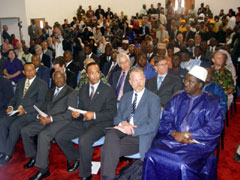
appropriate. The formal opening of these premises
could also be described as a special occasion.
I am therefore grateful to you Mr Justice Robertson,
President of the Court, for the invitation to
be present at this ceremony as the guest of
honour, and to formally open the Courthouse.
While
we take pride in the establishment of this unique
institution, and while we applaud the quality
of cooperation between the Government of Sierra
Leone and the United Nations, we cannot help
but recall with deep sorrow the extraordinary
circumstances that prodded us to pursue this
uncharted course in the administration of justice.
Never in the history of this country and of
West Africa have we experienced horrendous brutality
against innocent civilians on such a scale.
Those acts tarnished the image of Sierra Leone,
a small but peaceful, friendly and enlightened
nation.
This
notwithstanding, and long before the UN Security
Council adopted resolutions stressing the need
to talk to the rebels and try to end the war
peacefully, and long before we were persuaded
to negotiate with those who had committed heinous
acts of brutality and terrorism against our
people, my Government had already initiated
a series of dialogue with the leader of the
rebel movement. We concluded two peace agreements
with him, gave him and other members of his
movement cabinet and high-ranking positions.
We went further to grant them the most profound
and generous consideration one could imagine,
namely amnesty. And lest we forget, Foday Sankoh
also received absolute and free pardon under
Section 63 of the Sierra Leone Constitution.
Mr
President of the Special Court, it is relevant
on this occasion to recall the judicial, moral
and political risks that we took five years
ago when we allowed the rebel leader Corporal
Foday Sankoh, to leave this jurisdiction so
that he could travel to Lome for peace talks,
even though he had been convicted, sentenced
and was waiting to have his conviction reviewed
by the Sierra Leone Court of Appeal. It was
an unprecedented decision, one that apparently
escaped the attention of the international community
including the international media. The people
of Sierra Leone were apprehensive that Foday
Sankoh would never return to Sierra Leone to
face justice. However, yearning for peace, they
gave me their overwhelming support, and Foday
Sankoh, a convicted man, travelled out of this
jurisdiction.
We
all know what happened after Lome. How can anyone
forget the events of May 2000, less than a year
after the Lome Peace Agreement, when impunity
raised its vicious head once again on an already
traumatized population?
Mr
President of the Special Court, what happened
in Sierra Leone was not just an internal issue.
It was not, as some erroneously described it,
a civil war. It was, as I have always maintained,
a war of aggression aided, abetted and fuelled
by networks of ruthless merchants of illegal
diamonds and illegal arms. By virtue of their
acts, they were merchants of death and destruction.
We were relieved when the Security Council subsequently
acknowledged the international and regional
dimensions of the conflict and determined that
the situation was a threat to international
peace and security. Therefore the suffering
of the people of Sierra Leone became a matter
of concern to people everywhere, to humanity
as a whole. As I told the UN Secretary-General
in my historic letter of 12 June 2000, and I
quote:
"I
believe that crimes of the magnitude committed
. . . . in this country are of concern to all
persons in the world, as they greatly diminish
respect for international law and for the most
basic human rights. It is my hope that the United
Nations and the international community can
assist the people of Sierra Leone in bringing
to justice those responsible for those grave
crimes."
So,
this is a Special Court for Sierra Leone, a
symbol of the rule of law and an essential element
in the pursuit of peace, justice and national
reconciliation for the people of Sierra Leone.
It is also a Special Court for the international
community, a symbol of the rule of international
law, especially at a time when some State and
non-State actors are increasingly displaying,
shamelessly, contempt for the principles of
international law, including international humanitarian
law and human rights law. This Special Court
is good for Sierra Leone. It is also good for
the world today. It will certainly contribute
to the jurisprudence of international humanitarian
law, and enhance the promotion and protection
of the fundamental rights of people everywhere.
Without
the cooperation of the United Nations, the international
community and the Government and people of Sierra
Leone there would have been no Special Court.
This is why I should like to take this opportunity
to express sincere thanks, first to the Secretary-General
of the United Nations. He responded expeditiously
to my request, and the Security Council gave
him only thirty days to come up with a plan
based on my proposal for the creation of an
independent special court. At this point, I
should recognize and pay tribute to Hans Corell,
who as Legal Counsel and Under-Secretary General,
Office of Legal Affairs made a distinctive contribution
to the establishment of the Special Court. We
are delighted that you can join us today for
the ceremony, which incidentally, coincides
with the end of your service to the United Nations.
When you look back on your days at the UN you
will recognize the establishment of this Court
as one of your main achievements.
Our thanks also go to the States and organizations
that have made financial and other contributions
to the Court, and to members of the Management
Committee for their support and oversight function.
I am delighted to see their representatives
present at this ceremony.
Let
no one underestimate the formidable task and
challenge that this "hybrid" institution
faces and will continue to face in its lifetime.
The entire world, especially the people of Sierra
Leone, would be watching its proceedings, carefully.
The Court must see that justice is done. It
must also, as far as possible, by its proceedings
and judgements, dispel any notion that it is
a political tool of a particular government
or group of States. This is crucial to its success
because of perceptions and misperceptions about
the so-called "thin line" between
politics and the administration of justice on
the one hand, and international politics and
international law on the other.
On
the issue of its independence and credibility
the Security Council in its resolution 1315(2000)
of 14 August 2000, correctly emphasized the
importance of ensuring the impartiality, independence
and credibility of the judicial process of the
Special Court, in particular with regard to
the status of the judges and the prosecutors.
In
this connection, I would like to assure you
Mr President that we have absolute confidence
in the competence and integrity of all those
who have been appointed to serve in the Chambers
and Registry of the Court. I would also like
to commend you for the effective sensitisation
programme that is being conducted throughout
the country. The programme is a necessary acknowledgement
of the fact that (a) this particular mechanism
of accountability is new to the people of Sierra
Leone, and (b) it has emerged almost concurrently
with the proceedings of the transitional justice
mechanism embodied in the Truth and Reconciliation
Commission.
I
would strongly recommend that the Court continue,
and even strengthen the sensitisation or public
information programme. We note with interest
recent improvements in accessibility to information
on the Court's Internet website. Further improvements
would ensure that the Court's external constituencies
are also kept fully and reliably informed about
the activities of this new institution in international
humanitarian and human rights law.
Mr President of the Special Court, I would like
to reassure you that the Government of Sierra
Leone is fully committed to the success of this
Court, and will continue to cooperate with its
organs at all stages of the proceedings, in
accordance with Article 17 of its Statute. Such
cooperation is in the interest of the people
of this country, in particular the victims of
the atrocious crimes that the Court has been
empowered to try.
I
would like to commend the architects who designed
this impressive structure, and the builders,
workers and all those who in one way or the
other were recruited to lend a hand so to speak
in the construction of the building within such
a short time. The fact that the proceedings
of the Special Court will be conducted in a
spacious and relatively comfortable working
environment should enhance its overall efficiency.
At
the end of its mandate the Special Court will
leave a legacy in the annals of the administration
of justice in Sierra Leone and in the international
community. It will also bequeath to the people
of Sierra Leone a citadel of justice in the
form of this beautiful courthouse.
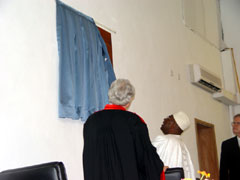
I
have the honour to now formally declare open
the new home of the Special Court for Sierra
Leone.
I thank you all.
-End-


