|
ADDRESS BY HIS EXCELLENCY THE PRESIDENT
ALHAJI DR AHMAD TEJAN KABBAH
AT THE COMMISSIONING OF
THE SIERRATEL DIGITAL
TELEPHONE EXCHANGE IN BO
ON 3RD APRIL 2004
(SALUTATION)
The role of communications and indeed telecommunications
in particular, in the political, economic, social
and technological development of Nations cannot
be over-emphasized. Not too long ago, however,
a diplomat in conversation with me described Sierratel's
main exchange equipment as a collector's item
that will be better used if kept on display at
our National Museum. I asked him why and his reply
was that the switchboard was obsolete.
You can therefore imagine my delight to receive
an invitation from the Board of Directors of Sierratel
to come to Bo today to commission a new digital
telephone exchange! I therefore thank the Board,
management and staff of Sierratel for giving me
this opportunity to be here today to launch this
digital Exchange which, from the evidence I now
have, is definitely not for our National Museum.
Our world is characterized by four main societal
environments. These are the political, economic,
social and technological environments, normally
abbreviated as PEST. In each of these environments,
telecommunications can, and as a matter of fact,
contribute immensely. Consider, for instance,
the number of very important official discussions
that take place over the telephone everyday at
both the national and international levels. Let
us also think about the number of ordinary personal
conversations that take place over telephone lines
every day, not to mention the number of messages
sent and received via the internet, the huge possibilities
offered by satellite communications that make
it possible for us to view television and digital
images on an infinite number of channels, and
more.
The
affordable and speedy exchange of information
in the goods, labour, money and capital markets
of any country's economy can contribute significantly
to the quality of decisions made with respect
to transactions carried out in those areas. One
of the main considerations in determining the
degree of competition within markets is the extent
to which sellers and buyers have accurate and
reliable information about market conditions.
Competitive markets can lead to economic efficiency
which in turn can serve as a powerful stimulant
to economic growth.
It is the realisation of the significance of the
telecommunications industry as an engine of growth
and a vehicle for the transfer and distribution
of information and data in the economy that led
my government, as far back as the year 2000, to
formulate a policy for the rehabilitation of the
fixed line services of Sierratel with the hope
that that development would be accompanied by
the introduction of competitive cellular, mobile
telephone services.
But
soon afterwards Government realised that Sierratel
was incapable, both managerially and financially,
to achieve the objectives of that policy for the
modernisation of the telecommunications industry.
The only option then open to it was to privatise
the company and at the same time introduce a Telecommunications
Act. The Regulatory Authority for the industry
to be established under that legislation would
take care of the issuance of licences particularly
for Very Small Aperture Terminals (VSATs) and
Internet Service Providers (ISPs), and would ensure
that operators do not infringe the terms of their
licences and maintain competition within the industry.
Government sought help from the International
Finance Corporation of the World Bank for the
process of privatising Sierratel but the transaction
itself collapsed in 2002 when, Spectronics, one
of the key potential investors for Sierratel pulled
out of the bidding process.
Because
of the lack of financial prudence and disharmony
at both the Board and management levels, Sierratel
has been unable to meet the challenges to its
market share by Celtel and Millicom who now together
have about 100,000 subscribers as opposed to Sierratel's
23,000. Obviously its failure to provide adequate
fixed line services to meet the increasing demand
for telephones is a contributory factor to its
loss of market share. The company spent most of
2003 pursuing a joint venture partnership for
a mobile service that was commercially unsound
and consequently not supported by Government.
Towards
the end of 2002, Government opened up competition
in the industry with the expectation that a Regulatory
Authority would have been in place by the first
quarter of 2003. A year has since elapsed without
the establishment of such an authority. Meanwhile,
uncontrolled competitive market forces have emerged
in the market place that have partly contributed
to the prevailing rising phone costs and also
to the recent instability in the foreign currency
markets. This development witnessed a surge in
the demand for foreign exchange from Internet
Service Providers and VSAT operators to fulfil
their overseas obligations.
During
2003 my attention was drawn to some financial
and other irregularities in the company which
could have been contained if there was unity at
both Board and management levels. This situation
has made it difficult for the company to focus
on the necessary remedial actions that should
be taken jointly by the Board and management to
improve financial controls and the proper supervision
of the company's operations. Government is concerned
that these corporate financial malpractices have
also made it impossible for the company to pay
dividends to government since I became President
in 1996. In normal competitive private market
conditions, a situation such as this would be
a recipe for a take-over bid, resulting in the
company's new owners dismissing the non-performing
management. As a first step, however, Government
and the National Commission for Privatisation
have injected some fresh blood into the Board
with a view to bolstering its strength and thereby
restructuring and streamlining the management
of the company. We look forward to some progress
flowing from this initiative.
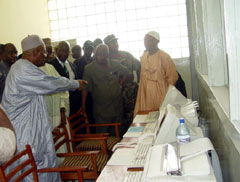
Let
me now turn to the main reason for which we are
here today. During the last few months government
deliberately embarked upon decentralising the
political process by holding regional cabinet
meetings in all the provincial headquarters and
is now preparing the ground for local government
elections to be held in May 2004. The dispersal
of zones of economic development away from Freetown
to the provinces is a corresponding economic expression
of our policy of decentralisation. The Commissioning
of this digital telephone switch board in Bo today
is an example of this trend and marks the end
of the first phase of Sierratel's programme of
providing modern telecommunications services in
the provinces, which involves the replacement
of a total of 1300 lines of old electro-mechanical
switches in Bo, Kenema and Lungi that were installed
over thirty five years ago, with a four fold increase
in digital lines totalling 5000.
In
Bo, 2000 new digital lines will replace 500 old
ones, whereas in Kenema 1500 new lines will replace
500 old ones. Lungi will have another 1500 new
lines to replace the old 300 lines. This new facility
makes it possible for calls to be made from Bo,
Kenema and Lungi by International Direct Dialling
(IDD) worldwide and within the country. Internet
access is therefore now possible to large databases
globally from these three localities in Sierra
Leone. Additionally telephone services have been
restored at Rotifunk and Moyamba.
Sierratel's
second phase of restoring telephone services in
the provinces has already started with the refurbishment
of microwave radio stations that were destroyed
during the rebel war in Segbwema, Landofeh mountains,
Koidu, Port Loko, Lunsar and Makeni. This is to
be followed by the installation of digital systems
before the end of 2004. Around 63% of these microwave
radio stations are currently powered by solar
energy which is environmentally friendly and relatively
inexpensive.
I have been informed that Management and the Board
have recently been developing a programme of collaboration
with Ericsson, a renowned Telecommunications Company
from Sweden, to add to its operations a mobile
phone service and wireless land phone facilities
that can be installed in remote rural communities
with minimum infrastructural development.
Government welcomes this initiative, the realization
of which, I understand will pave the way for a
renewal of the Company's direction. The successful
implementation of this project will be a test
of the renewed commitment of the Board and Management
to raise the level of performance of Sierratel
and prepare the company for meeting the challenges
it now faces in a highly competitive environment.
I note that similar upgrading of the telephone
facilities has commenced with the refurbishment
of microwave radio stations in Port Loko, Lunsar
and Makeni. It is important that greater attention
is now directed at the Northern Region which has
lagged behind in the telephone rehabilitation
process because of continued rebel presence in
the region even at the latter period of the war.
As
I have said at the outset government is aware
of the enormous economic and social benefits to
be derived from the provision of an efficient,
affordable and accessible communications system.
It is for this reason that government supports
such policies as the privatisation of Sierratel
and the setting up of a Regulatory Authority to
stimulate healthy and constructive competition
in the industry. The management of Sierratel is
therefore urged to adopt measures that would make
Sierratel attractive to serious external investors
who could bring to the company both new money
and modern technology. The Ministry of Transport
and Communications and the National Commission
for Privatisation should endeavour to make arrangements
for the speedy enactment of the draft Telecommunications
Bill so that confidence can be restored and orderly
competition can take root in the industry. These
measures, it is hoped, will also put a check to
the current exorbitant increases in cellular mobile
telephone charges, and thus reduce the burden
of high charges on the ordinary citizen.
It now gives me great pleasure to officially declare
the new digital exchange in Bo open, which also
covers Kenema, and to thank you all for your attention.
-End-
|


