|
ADDRESS BY HIS EXCELLENCY THE PRESIDENT, ALHAJI
DR AHMAD TEJAN KABBAH ON THE OCCASION OF COMMISSIONING
OF A RICE MILL DONATED BY THE GOVERNMENT OF THE
PEOPLE'S REPUBLIC OF CHINA IN BO,
ON 3RD APRIL 2004
It
is a great pleasure for me to be here today to
commission a rice mill donated by our friends,
the People's Republic of China. The Chinese Government
has been providing agricultural assistance to
this country for over three decades now. Their
efforts are easily visible in more than 4000 hectares
of developed inland valley swamps throughout the
length and breadth of this country, the Makali
Agriculture Station with their fish ponds, the
Lumley Agriculture station where there is a thriving
Poultry Project and the Ogoo Farm Development
project where farmers are benefiting from the
cultivation of not only rice but also exotic and
traditional vegetables. For this we shall remain
ever grateful to the Chinese Government and the
people of China. These facilities have substantially
supported our burning desire to achieve food security
in this country. In addition we are presently
discussing with the Chinese government some project
proposals that will have a profound impact on
our policy for food security by the year 2007.
My presence here today is a clear manifestation
of my commitment to my pledge to ensure that by
2007 no Sierra Leonean will go to bed hungry.
I am pleased to note that the people of Bo District
have positively responded to my call for the involvement
of everybody to ensure that my pledge becomes
a reality. Information available to me indicates
that since the declaration of the end of the war
and my pronouncement to fight hunger and poverty,
the people of Bo, under the wise leadership of
Paramount Chief Kamanda-Bongay, have more than
doubled their agricultural production.
In 2003, Bo District increased their rice production
by 100%, from about 22,000 metric tons in 2002
to 44,000 metric tons in 2004, representing 10%
of the total national production. Similar increases
have been observed in the other agricultural crops.
To the Paramount Chiefs, Sub Chiefs and farmers
of Bo District, I want to congratulate you for
your efforts. As a comparison it will interest
you to note that the national increase in production
of rice was less than 10% from 2002 to 2003.
Because of your commitment to food security, my
Government has thought it prudent to ensure that
your efforts do not go unnoticed. We are aware
that post-harvest losses in rice production can
go up to about 30 percent of potential production
and that traditional rice milling alone contributes
to about 8 percent of such losses. It is also
known that the use of rice mills can reduce these
losses to less than 3 percent. If we translate
this to absolute figures we are saying that you
can save nearly 10 cups of milled rice for every
bag of milled rice you produce. For many homes
this is more than a day's meal. For this we must
feel gratified that we are starting the gradual
transition from traditional milling of rice to
improved mechanized milling.
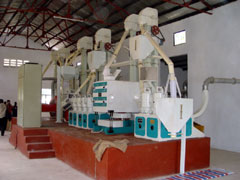
It must also not be forgotten that most of the
rice milling is traditionally done by women who
we all know are already overburdened with farm
and household work. The use of rice mills will
relieve our wives and girl children from the arduous
work of pounding. The labour so relieved can then
be more profitably utilized in farm and other
income-generating activities, or even be utilized
to go to school in order to raise the educational
standard among our female population.
Government is striving to do everything possible
to ensure that my pledge of food security becomes
a reality. To this end, we will continue to support
mechanization efforts that will increase areas
under cultivation and reduce the demand on human
labour. There is no way we can feed ourselves
and attain food security if we depend entirely
on hand and hoe agriculture. For this purpose
we are encouraging our friends and partners to
establish an agricultural machinery plant in this
country in the not too distant future. A company
from the People's Republic of China has indicated
interest in constructing a factory in Freetown
to produce tractors and other agricultural machinery
to serve the West African market. In this regard,
government hopes to take advantage of the huge
trade and other possibilities within Ecowas Member
States as a ready market for tractors and other
agricultural implements produced in Sierra Leone.
It
is my fervent hope that when that factory begins
its operations, not only will agricultural machines
be available on the local market, but the factory
will create new jobs and thereby stimulate other
economic activities. To complement this and ensure
that farmers are able to own and have access to
these machines, government is in the process of
finalizing plans for the setting up of a hire-purchase
scheme. The modalities of this scheme are being
discussed with the major banks in Freetown.
I am also aware that the provision of credit facilities
can encourage and boost farming. The Bank of Sierra
Leone has established rural banks in certain places
and will continue to do so in other parts of the
country. The banks will be encouraged to give
out loans for agricultural purposes at reasonable
interest rates.
I want to take this opportunity to call on all
donor agencies, multilateral organisations and
friends of this country to support the significant
initiative of the Chinese Government in the Bo
District. Agro-processing facilities are not limited
to the provision of rice mills alone. Bo District
farmers also need oil palm presses, cassava graters,
drying floors and stores. They also need support
in the provision of basic inputs such as planting
materials, fertilizers, pesticides and basic farm
tools to complement the efforts of the Ministry
of Agriculture, Forestry and Food Security.
Before
I conclude let me say something about the recent
escalation of the prices of our basic foodstuff,
rice and palm oil. My Government has, with the
positive support of people like Paramount Chief
Kamanda-Bongay, taken action to ensure that the
prices of basic food items do not soar above the
means of the ordinary man. In the short term,
a temporary ban has been put in place on the export
of food items from this country and Government
has been holding discussions with major importers
of food items to ensure that the prices of these
commodities are not unduly increased. Because
of certain measures taken by government in this
regard, you will have experienced that in recent
weeks the prices of rice and palm oil have decreased.
We should realize that for far too long we have
been pursuing policies that create problems for
us. We talk about unemployment and yet for many,
many years past governments have popularised the
importation of our staple food. By importing our
staple food from overseas we are, in effect, exporting
job opportunities to foreign countries. By importing
rice from these countries we are deliberately
increasing the price of our staple food because
a consignment of imported rice to Sierra Leone
would normally take at least one and a half months
on the high seas and freight charges constitute
a substantial part of the cost of rice. By growing
rice locally and thereby eliminating freight charges,
there will be a drastic decrease in the cost of
rice.
With this in view I have instructed that (1) all
seed rice bought by the Ministry of Agriculture,
Forestry and Food Security for distribution to
farmers must be bought directly from Sierra Leonean
farmers, thereby eliminating middlemen and creating
a market for our farmers and by extension for
the people of Sierra Leone; (2) that all rice
bought at public expense for our security forces
and other institutions such as hospitals, must
be bought from the regions where those institutions
and the troops are located. This will not only
cause savings on transport but will also create
a guaranteed market for local farmers in the regions
concerned.
If we all cooperate in this, no one will ever
complain about the cost of rice, and contrary
to pessimists, our target of attaining food security
by 2007 will be met. It would have been not only
a dream but a reality.
Mr Chairman, Ladies and Gentlemen, it is my pleasure
to now formally commission this rice mill. It
is my hope that the people of Bo District and
the neighbouring districts will make maximum use
of it.
I thank you all.
.
-End-
|


