|
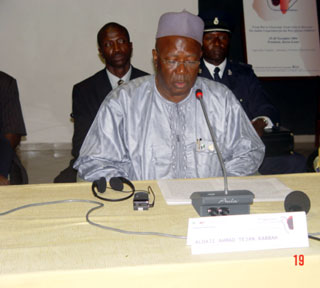
STATEMENT
BY HIS EXCELLENCY
THE PRESIDENT
ALHAJI DR. AHMAD TEJAN KABBAH
AT THE INTERNATIONAL CONFERENCE ON CHILDREN ORGANISED
BY ITALY AND WFP
IN COOPERATION WITH WEST AFRICAN MINISTERS AND PARLIAMENTARIANS
IN A FORUM IN FREETOWN
ON FRIDAY, 19TH NOVEMBER, 2004
EXCELLENCIES
HOUNARABLE MINSTERS
HOUNARABLE SENATORS
HOUNARABLE MEMBERS OF PARLIAMENT
MEMBERS OF THE DIPLOMATIC CORPS
DISTINGUISHED LADIES AND GENTLEMAN:
It gives me great pleasure to warmly welcome you, our
distinguished and honoured guests present here today.
I am particularly delighted that you are here to discuss
issues affecting our children in conflict situations
and how we could save their future by letting them discover
once more their childhood.
Let me, in doing so, express my gratitude on behalf
of the Government and people of Sierra Leone to the
Government of Italy for conceiving the idea of hosting
this auspicious conference in our country. We in Sierra
Leone are pleased that the Government of Italy chose
Sierra Leone as the venue for such an important conference.
The choice of Sierra Leone for such a meeting came as
no surprise. Our experience in eleven years of conflict
and the adverse effect it has had on our human resources
particularly on our children qualifies this country
as an appropriate venue for holding this conference.
Distinguished
Ladies and Gentlemen:
Sierra
Leone has a lot of experience to share with other countries
in this matter. Africa, West Africa in particular, has
witnessed in recent times some of the most intractable
and gruesome forms of violence in the world. Combatants
involved in these conflicts have not only taken the
form of militias, bandit groups and mercenaries but
have actually forcibly recruited child soldiers into
their ranks. For over a decade Sierra Leonean children
as well as those in neighbouring countries like Liberia
have known nothing but war; they have grown up listening
to the sounds of gunfire, bombs and high explosives:
they have participated in some of the most gruesome
scenes of warfare ever to have been witnessed in the
world, so much so that I wonder whether all of them
have now sufficiently undergone the psychological healing
from the trauma of that war. They lost their chance
to participate in the ordinary pleasures of childhood,
to attend school or even be considered as children.
Many of them have opted to become mercenaries travelling
within the sub-region and even beyond because they know
no other trade except that of war. That is why, we as
a region, must find a solution to the problems connected
with and flowing from the circumstances in which they
found themselves. Our children were the most vulnerable
and they suffered both as victims and as perpetrators.
Some were abducted and forced to take up arms while
others were amputated, tortured, separated from their
parents, sexually abused, deprived of education and
access to medical facilities.
Distinguished
Ladies and Gentlemen:
One
of the most adverse by-products of that war is the effect
it had on the attitude, mentality, behaviour and even
language of our children. Perhaps they now need, for
their re-orientation, some educational tools or visual
aid materials which would facilitate such re-orientation
of their minds and thinking and help them in resuming
their proper position in society by acting and thinking
once more as children.
The
availability of such aids is not easily accessible to
or affordable by some of the affected countries. The
need for such aids is even greater in the case of children
who lost both parents and close family members. It must
be stated here that the human mind is a powerful instrument
in the formation of the individual and it should be
always directed in the proper course especially in developing
countries where skilled manpower is scarce and is necessary
for the development of such countries.
The cause of most of these conflicts is to a large extent
related to the issues of bad governance such as political
marginalization, greed, corruption, non-transparent
elections, religious intolerance, and ethnic cleansing.
These unfortunate developments have not only impacted
negatively on the economies of countries in the sub-region
but also on our children and their future.
In
the last decade, civil wars have set ablaze a number
of countries in West Africa including our country Sierra
Leone, Liberia, Guinea-Bissau, Mali, Niger and more
recently la Cote d'Ivoire, thus adversely affecting
the children and the future of these countries.
It is for this reason that my Government continues to
take the position that the promotion of human rights
and the tacit application of fundamental freedoms lies
within our national interest and indeed the national
interest of every state. This is so because states that
protect human rights are those best able to secure peace,
promote economic development, create opportunities for
employment, especially of the youth combatant, international
terrorism and crime, and avoid humanitarian crises.
The
Government of Sierra Leone remains committed to democratic
principles, the promotion of good governance, the rule
of law, public accountability and transparency, the
negation of the culture of impunity and propagation
of gender equality. We do so because we believe that
democracy promotes individual rights and freedoms and
is a means for every one to benefit from being a citizen
of a state, which is part of a globalized world. We
value the human kind, particularly its potential to
improve the quality of life for human beings. To waste
that potential or retard its development is an unpardonable
error which all nations should strive to prevent.
Distinguished
Ladies and Gentlemen:
We
have witnessed that democratically governed nations
are more likely to secure peace, deter aggression, expand
open markets, promote economic development, rule responsibly,
and improve human health. Democratic principles, such
as the rule of law and accountability do not only protect
the rights of citizens from unjust or capricious actions
of government but also provide the stable, secure climate
that encourages investment and economic growth. The
absence of these strong traditions will inevitably deter
civil society to flourish, discourage sustainable development,
completely prohibit adequate checks on executive and
legislative power, and dissolve the legal foundations
for free and fair electoral and political processes.
Distinguished
Ladies and Gentlemen:
Because of our consciousness and sensitivity to the
consequences of conflicts particularly on our children,
we took measures at the end of our war to put in place
mechanisms to address such consequences. Some of the
measures include the creation of a National Commission
for War Affected Children (NaCWAC). By an Act of Parliament
in January 2001, that commission was established to
advocate and facilitate the implementation of international
norms and standards on the rights and protection of
war-affected children. The Ministry of Social Welfare,
Gender and Children's Affairs, in liaison with the other
child protection agencies like UNICEF, has been working
with these agencies to meet the welfare and protection
needs of our women and children. Both agencies ensure
that the concerns of our children in general are translated
into policies, priority setting and resource allocations
at the highest political level.
A number of priority areas were identified for Government's
intervention. These included child rights advocacy and
monitoring of child rights violation, street children
and juvenile justice, family tracing, reunification
and reintegration of separated children, demobilization
and reintegration of child ex-combatants. Those processes
were successfully completed in the DDR programme by
December last year and emergency response programme
for refugee and returnee children from neighbouring
countries. Government has also been very supportive
of the efforts of local and international organizations
in addressing child rights issues. To this end, IMATT
and UNAMSIL have been particularly helpful in restructuring
our security forces and providing them with training
in human rights education and international humanitarian
law, while UNICEF has facilitated children's programmes
precisely aimed at bringing the best out of these children.
Because of the many instances of human rights violation
especially against children, Government with the support
of its bilateral and multilateral partners put in place
mechanisms and established structures to address the
many human rights violations committed at all levels
in the Sierra Leone society. These include the establishment
of the Truth and Reconciliation Commission which has
completed its work and submitted its report. The Government
White Paper on this is now at an advance stage of preparation
in consultation with the UN Commission for Human Rights.
Also, the United Nations backed Special Court is currently
trying those who bear the greatest responsibility for
gross human rights violation committed during the war.
The National Commission for Democracy and Human Rights
is teaching human rights in schools and sensitizing
the public through the media, music and drama on human
rights and related issues.
Distinguished
Ladies and Gentlemen:
In our commitment to the International Community's effort
at child protection, Sierra Leone has signed and adopted
a number of international instruments such as the Convention
on the Rights of the Child; The African Charter on the
Rights and Welfare of the Child; Optional Protocol on
the Convention of the Rights of the Child, Convention
on the Elimination of all forms of Discrimination against
Women, and the enactment of the 1989 Adoption Act. The
Law Reform Commission is currently reviewing our laws
in order to ensure that they prohibit all forms of violence
against women and children. Parliament has enacted legislation
the object of which is to prevent the recruitment of
children into the army or the use of children for any
combat activity. The policy of Government is not to
recruit children below the age of 18 into the Army.
To encourage parents to send their children to school,
my Government has also declared and now provides free
education for all school going children at the primary
level and provides books and other school materials
for pupils. The ultimate aim is to provide free education
to all our school going children. The education of the
girl child is particularly of interest to my Government.
For this reason centres have been opened for promoting
the education of the girl child at the community level.
Distinguished
ladies and gentlemen, with our experience in conflict,
in spite of our limited resources to adequately address
the consequences flowing from such conflicts, the Government
and People of Sierra Leone believe that this is not
the time for our region and indeed the entire continent
of Africa to start tearing each other apart. By avoiding
dialogue and engaging in conflicts we will not only
be destroying the meagre resources we have but subjecting
our children to misery and suffering. The effects as
we have seen and witnessed transcend national and international
boundaries. As leaders of today, it is our responsibility
to come together and iron out our differences in an
amicable manner for peace and stability to prevail in
our region and indeed the world at large so that a better
future could be ensured for the children of the world.
Distinguished
Ladies and Gentlemen:
I should note that the World Food Programme (WFP) has
been extremely helpful in providing assistance to our
displaced population as well as refugees in this country.
We therefore appreciate their participation in this
particular Conference. We are grateful for their continued
support in their traditional areas of assistance to
Sierra Leone. We welcome their intention to renew their
assistance to the School Feeding programme. However,
in keeping with our policy to ensure that no Sierra
Leonean goes to bed hungry by 2007, we believe that
WFP can play a pivotal role in the implementation of
this policy by arranging to buy whatever surplus food
may be available in Sierra Leone in support of programmes
in Sierra Leone and other countries. This will certainly
provide the much needed markets as an incentive to our
farmers. In addition to this, where there is a shortfall
of funding to keep feeder roads in serviceable conditions,
we also suggest that they consider the introduction
of food-for-work programmes in Sierra Leone to help
farmers with the transportation of their farm inputs
and farm products.
In this endeavour, we continue to look forward to our
international partners for proactive cooperation so
that our sub-region would be able to shape and move
our children from war to the classroom and from crisis
to full recovery, with a strong and vibrant economy
for them to build on. I believe that it is in this light
that we should evaluate the Italian initiative on the
subject matter of this Conference. I would therefore
like to take this opportunity to once more express my
particular appreciation to the Italian Government, especially
the high level delegation consisting of top public officials
and dignitaries, the organizers of this conference,
and participants from other countries for coming to
Sierra Leone to join in identifying solutions affecting
our children in this sub-region.
May your deliberations be blessed with success.
I
thank you.
===========================
|