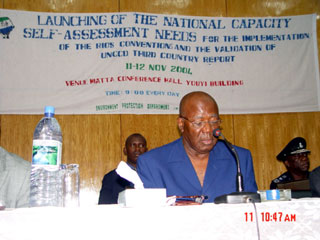
|
KEYNOTE
ADDRESS DELIVERED BY
HIS EXCELLENCY THE PRESIDENT,
ALHAJI DR AHMAD TEJAN KABBAH
AT
THE LAUNCHING CEREMONY OF THE
NATIONAL CAPACITY SELF-ASSESSMENT
(NCSA) NEEDS PROJECT AND THE VALIDATION
WORKSHOP FOR THE PREPARATION OF THE
COUNTRY REPORT ON THE UNITED NATIONS
CONVENTION TO COMBAT DESERTIFICATION/
LAND DEGRADATION (UNCCD)
AT THE MIATTA CONFERENCE HALL,
YOUYI BUILDING, BROOKFIELDS
ON NOVEMBER 11, 2004
Mr Chairman
Cabinet Ministers
Honourable Members of Parliament
Representative from UNDP
Country Representative from the EU
Your Excellencies
Members of the Diplomatic and Consular Corps
Heads of Government Departments and Local
Governments
Distinguished
Ladies and Gentlemen:
It
is indeed a pleasure for me to be here at the
launching ceremony of the National Capacity Self-Assessment
Needs Project for the implementation of the Rio
Conventions by Sierra Leone and the Validation
Workshop for the preparation of the Third Country
Report on the United Nations Convention to Combat
Desertification/Land Degradation. The project
and the report preparation is a clear indication
of my Government's commitment to achieve sustainable
development in Sierra Leone.
We
are assembled here to start a very important decision
making process in developing a proposal to strengthen
our institutional capacities to implement three
important Conventions, which are to be used to
Combat Poverty according to the Millennium Development
Goals, sanctioned by African Leaders in Maputo,
Mozambique. Two years ago these Multilateral Environmental
Agreements (MEAs) were accepted as the Environment
Programme areas for the New Partnership for Africa's
Development (NEPAD) Initiative. Fortunately, Sierra
Leone is a Party to the Rio Conventions namely:
v The United Nations Convention on Biological
Diversity (UNCBD)
v
The United Nations Convention to Combat Desertification
(UNCCD)
v
The United Nations Framework Convention on Climate
Change (UNFCCC).
The
successful implementation of the three Multilateral
Environmental Agreements require enhanced capacity
for institutions involved in Natural Resources
Management. Consequently, it is on this basis
that my government requested the United Nations
Environment Programme (UNEP) and the Global Environment
Facility (GEF) to assist us in the preparation
of a proposal for the National Capacity Self-Assessment
Needs (NCSA) Project in these three thematic areas
of environmental management. They hinge on human
existence or survival. Implementation of this
project is timely as government is also aware
of the capacity needs of our natural resource
management. Moreover, this could give us an opportunity
to assess the capacities of the various local
councils being put in place since they are to
be the key institutions in implementing the programmes.
Mr
Chairman, Distinguished Ladies and Gentlemen,
the main objective of this NCSA project is to
enable Sierra Leone to identify constraints and
priority needs for effective implementation of
the three environmental conventions mentioned
above. Furthermore, the assessment will help avoid
duplication and conflicting directions of efforts,
and identify major overlaps in the activities
of the three conventions with the aim of building
synergies, since they are closely related. I therefore
urge the Ministry of Lands, Country Planning and
the Environment to closely collaborate with line
Ministries, Departments, NGOs, CBOs, Private Sector
and all stakeholders in natural resources management
to produce a reflective proposal on capacity building.
The
mounting pressure on our natural resources, particularly
the illegal forest exploitation has been mainly
responsible for the extensive land degradation,
and drastic changes in the weather patterns, which
has resulted in excessive heat and the force of
storms. It has also affected the watershed and
catchment areas leading to the early drying up
of our once perennial rivers and streams. There
is a continuing loss of biodiversity and wildlife
and a gradual decent of the savanna eco-system
in once forested areas. The rapid and uncontrolled
sand extraction along our tourist-attraction areas
is posing much concern to Government.
Aware
of the destructive effect of such activities on
future generations, my government and our partners
are currently undertaking sustainable forest management
and biodiversity conservation in different parts
of the country. In this we have been collaborating
with both national and international NGOs as well
as with Funding Agencies, to put in place a new
approach in forest protection such as the Gola
Forest Conservation Concession Project that will
address not only the protection of the forest
and its biodiversity, but will also provide sustainable
benefit to the local community in perpetuity.
In this connection we are disturbed by reports
of a resurgence of logging activities for export.
Government will take appropriate and prompt steps
to arrest this development.
My
Government is also working with the National Environmental
Forum to address the sustainable environmental
management of the Western Area Peninsula Forests
and the adjacent coastal wetlands such as the
Sierra Leone River Estuary and Yawri Bay - both
being recognized as wetlands of international
importance.
As
we are all aware the Western Area Peninsula Forests
are the main source of water to the Guma and Congo
dams on which the supply of water to Freetown
and its environs depends. Following the NEPAD
meeting in Maputo, Government is also working
with other stakeholders to develop eco-tourism
in the Western Area Peninsula Forest, in the Outamba-Kilimi
National Park (OKNP), in Tambaka Chiefdom in the
North and on Tiwai Island in the Southeast. In
this regard we are contacting other NEPAD members
like Kenya and Tanzania which have had a long
and successful experience in Eco-Tourism for their
expertise.
Mr
Chairman, Distinguished Ladies and Gentlemen,
let me also inform you that the Government of
Sierra Leone has to prepare a Country Report to
the Committee to review the implementation of
the United Nations Convention to Combat Land Degradation.
In this regard, studies and sensitisation meetings
have been held within the country with our Local
Government and Professionals in sourcing information.
A validation workshop for the preparation of this
report will take place tomorrow. For the preparation
of this Country Report, Provincial, District and
Chiefdom Coordinating Committees were formed.
This is a clear manifestation of devolving Central
Government responsibilities to our Local Governments,
where decisions are taken by the people themselves
at the grassroots.
Mr
Chairman, Distinguished Ladies and Gentlemen,
I should like to take this opportunity to thank
UNDP, GTZ and all other institutions which have
played a role in providing a sound environment
for all Sierra Leoneans. I also want to thank
the Minister of Lands, Country Planning and the
Environment and his team for their tireless efforts
in bringing this project to reality.
Mr
Chairman, Distinguished Ladies and Gentlemen,
I am appealing to all of us, especially the participants
in tomorrow's validation workshop to make a meaningful
and maximum contribution in order to produce a
cogent Country Report on Desertification/Land
Degradation which will give a clear picture on
Sierra Leone's situation.
With
these few remarks, it is now my singular pleasure
to formally launch the National Capacity Self-Assessment
(NCSA) Needs Project for Sierra Leone and to call
on key stakeholders to fully embrace the objectives
of this project.
I
wish you a resourceful deliberation.
Thank
you for your attention.
==============================
|