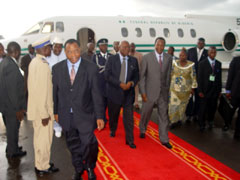
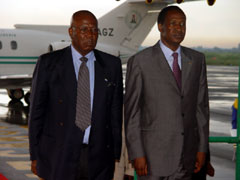
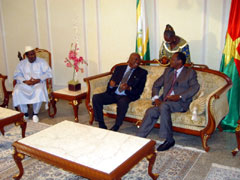
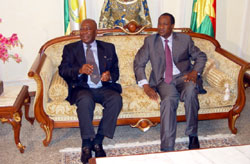
|
Intervention
By His Excellency
Alhaji Dr Ahmad Tejan Kabbah,
At The Extraordinary African Union
Heads Of State And Government Summit
On Employment And Poverty Alleviation
8-9 September 2004,
Ouagadougou, Burkina Faso
Mr.
Chairman
My dear brothers, Your Excellencies
Mr. Chairman of the African Union Commission
Mr. Director General of the International Labour
Organization (ILO)
Distinguished
participants
Ladies and Gentlemen:
I
would like, first of all, to convey my sincere
appreciation to our host, His Excellency, President
Blaise Compaoré and the Government and
people of Burkina Faso, for the kind reception
accorded us since our arrival in this beautiful
city, Ouagadougou.
I
want to also express my thanks and appreciation
to the Chairman of the African Union Commission,
His Excellency President Alpha Konaré and
his staff, the Economic Commission for Africa
(ECA), the International Labour Organization (ILO)
and other partners for the excellent preparations
for this Summit.
This extraordinary Summit convened specifically
to address the subject of employment and poverty
alleviation in our region is timely. It is fitting
that the Summit is chaired by our dear Colleague
and Brother President Olusegun Obasanjo who will
no doubt use his extensive experience and skills
to guarantee that tangible and practical results
emanate from our deliberations.
Mr.
Chairman, Your Excellencies,
Indeed, the bleak job picture, in terms of outright
unemployment and underemployment, is practically
one of our most urgent and destabilizing problems
in Africa. The lack of employment opportunities
compounded by inappropriate remuneration, fuel
social tensions and encourage the migration of
well-trained and talented Africans out of the
Continent. Regrettably, for many years since independence,
we have also tended to marginalize the problem
in our national socio-economic strategies and
policy interventions.
In
Sierra Leone and other post-conflict countries,
our employment situation is even more critical,
given the addition of hundreds of thousands of
ex-combatants, displaced persons and refugees
into our unemployment statistics. Furthermore,
agriculture, which is the main stay of our economy
and employs the majority of the population, however
has little impact on the employment problem, largely
as a result of its underdeveloped and subsistence
nature. Properly developed, agriculture offers
a reliable avenue for absorbing large numbers
of unemployed labour particularly the youth. It
can also be a ready source of export revenue and
wealth particularly in light of the concessions
offered to us under the US AGOA programme as well
as the EU "everything but arms" programme.
Since one of the quickest ways to generate large-scale
employment in some of our economies is through
the proper development of our agricultural sector,
this sector therefore can be considered as a prime
candidate for urgent donor support not only to
produce more agricultural products but add value
thereby creating well-deserved wealth.
Mr
Chairman, Your Excellencies,
The many young men and women who have been exposed
to conflict can easily find themselves trapped
in the cauldron of violence that may continue
to threaten the stability of our countries. Any
failure to address the employment concerns of
these categories of persons and on a timely manner
could reverse the progress we are making in rebuilding
peace and security. To do otherwise will be sowing
the seeds of future conflict. In general, therefore,
any long-term development framework has operational
meaning only when it is translated into opportunities
for gainful employment for all.
I
am delighted therefore that employment creation
is gaining explicit consideration as we actively
begin the process of formulating and pursuing
"second generation" reforms, in the
context of the PRSP framework, NEPAD, the Millennium
Development Goals (MDGs) and, of particular significance,
at the level of the African Union. These are certainly
powerful tools that should provide a sound basis
for addressing the problem of unemployment in
Africa.
Mr Chairman, Your Excellencies,
Many of our countries have made impressive efforts
to improve the climate for growth by restoring
and maintaining macroeconomic stability, raising
educational standards, opening up their economies
to the private sector, and integrating into the
global economy through trade liberalization and
other market-based policies. Our governments have
also adopted effective measures to run the affairs
of their states in a manner that is calculated
to provide hope for their citizens particularly
in the areas of responsible management of their
nation's resources and in maintaining open and
inclusive political systems that guarantee freedom
of expression and protect human rights. However,
there still remain formidable obstacles to overcome
if we are to achieve the objectives of creating
jobs and improving the living standards of our
people as envisaged in the "African Union
Action Plan".
Specifically,
we still need a bigger leap in GDP growth. Factors
constraining GDP growth must be addressed. More
detailed macroeconomic analyses would be necessary
to identify the pro-growth sectors and mainstream
them into national poverty reduction strategies,
even as we are mindful that inducing more labour-intensive
productivity may lead to lower wages.
While
the public sector remains the main driver of employment
and job creation, as employer of last resort,
it is no longer sustainable, given its inability
to create jobs fast enough to accommodate the
rising numbers of new entrants into the labour
market. However, it is still feasible for government-led
strategy for job creation to be implemented if
substantial external resources to support such
pro-employment schemes as road construction and
other public works are provided.
The
private sector has not achieved much in the way
of growth and job creation, particularly compared
with more dynamic emerging markets in Asia and
Latin America. This is in spite of the extensive
investment and other incentives that our governments
have offered to private investors. What may be
required is an injection of massive and sustained
development assistance to upgrade our infrastructure,
including energy, telecommunications and transport
facilities, as well as the need for donor countries
to be more proactive in encouraging potential
investors in their countries to invest in Africa.
Mr
Chairman, Your Excellencies,
It should now be clear that many African countries
cannot by themselves mobilize the volume of resources
necessary for the level of investment that will
lift their economies from the low level of performance
in which they currently find themselves. This
as we all know is not always due to lack of sincere
effort on our part but also due to historical
factors and prevailing conditions in the international
economic environment. Therefore, the role of development
assistance is critical in creating the conditions
for raising the level of employment in our countries.
In this connection, I would like to acknowledge
the role that South Africa and Nigeria in particular
have played as more advanced countries in Africa
in extending their investments to other African
countries in need of such investments. We therefore
hope that other African countries that are able
to do so will emulate this bright example.
I
should state, however, that some of our experience
has been that even in cases where development
assistance is offered there are often delays in
administering such assistance coupled with a web
of complicated procedures that minimize its impact.
It is therefore important that this situation
is critically examined to provide the necessary
relief to developing countries that is intended
by donor assistance.
Finally, Mr Chairman, we fully appreciate that
there can be no employment without investment,
nor can there be meaningful investment without
adequate security. Therefore the role of the African
Union in strengthening cooperation in the areas
of regional security and peace building should
be intensified.
I
thank you for your attention.
-End-
|