|
STATEMENT
BY
HIS EXCELLENCY THE PRESIDENT,
ALHAJI DR AHMAD TEJAN KABBAH
ON THE FORMAL LAUNCHING OF THE
NATIONAL ANTI-CORRUPTION STRATEGY
ON TUESDAY 15TH FEBRUARY 2005
As
you will recall, in December of last year, in
this same facility, we met to observe the 1st
Anniversary of the International Anti-Corruption
Day and also celebrate the publication of the
preliminary draft of our National Anti-Corruption
Strategy.
The
development of the National Anti-Corruption Strategy
(NACS) is a vital component of a comprehensive
national programme to combat corruption. Since
the promulgation of the Anti-Corruption Act in
February 2000, and thereafter, the establishment
of the Anti-Corruption Commission (ACC), development
of this important policy document was held up
by unforeseen delays. This set back, however,
is now a thing of the past as we gather here to
day to establish yet another significant milestone
in our commitment to tackle the scourge of corruption.
The
launching of the National Anti-Corruption Strategy
(NACS) is therefore a further demonstration of
my government's commitment to Good Governance,
institutional Reform and the eradication of corruption
in Sierra Leone.
The
importance of a National Anti-Corruption Strategy
(NACS) to help curb corruption in Sierra Leone
cannot be over emphasized. A National Anti-Corruption
Strategy (NACS) is a vital prerequisite in that
it embodies strategic action plans that have been
developed in consultation with a cross section
of society and stakeholders in Freetown and Regional
capitals in the country. This process culminated
in the National Consultative Group Meeting held
in Freetown on 2nd & 3rd February 2005, whose
main objective was to increase public participation
in the review and finalization of the draft National
Anti-Corruption Strategy (NACS) presented to the
Government of Sierra Leone on December 10th 2004.
This goal was accomplished by drawing on the experiences
and views of all facets of society. In addition,
the Consultative Meeting addressed the issue of
corruption in the country and assessed various
strategies for its eradication. As part of this
dialogue, participants were encouraged to comment
and provide input on specific sections of the
Strategy.
Participants
were also invited to:
Ø
Discuss attitudes towards, and the causes and
costs of corruption in Sierra Leone
Ø Identify the most urgent areas that require
reform
Ø Discuss specific measures to be included
in a viable National Anti-Corruption Strategy
Ø Establish ownership of and commitment
to the National Anti-Corruption Strategy
An
integral part of this process was the Integrity
Retreat attended by all Cabinet Ministers with
responsibility for the areas requiring urgent
reforms. The Retreat, during which plans for implementation
were further discussed, also provided an opportunity
for a final consultation with the ACC on the strategy
and to further discuss the issue of implementation.
I was made to understand by the Vice-President
that this high level meeting was very productive.
The
outcome of the various processes outlined above,
has provided us with the requisite tools to translate
our commitment to tackle corruption into a sustainable
action programme.
An
equally important factor is the quality of information
that is available to aid in establishing the key
priority areas for concerted action. Because corruption
is a symptom of inefficient institutions and poor
policies, it has often proven difficult to assess
where reforms are most needed. This experience
has taught us that there is a need for diagnostic
studies to be undertaken, as was the case with
the Governance and Corruption Survey in 2003,
in order to better understand the shortcomings
of policy formulation and the capacity of state
institutions to manage policies.
Another
crucial factor I must make bold to say is political
leadership. Any and every successful Anti-Corruption
effort must have the full backing of political
leadership, which my Government is committed to
providing.
Experience
has also led me to realize that fighting corruption
has distributional consequences, which can mobilize
powerful forces to protect vested interests at
any cost. It is for this reason that I will continue
to give my full support to the work of the ACC.
I, as President of the Republic of Sierra Leone,
expect the same level of political commitment
from all my Ministers and the people's representatives
in Parliament.
A
third, and perhaps the most important, element
in this process rests squarely with you my compatriots.
The formulation of the National Anti-Corruption
Strategy (NACS) has greatly benefited from the
participation of the public. The challenge we
now face is managing the implementation of the
Strategy. Are we going to consign this document
to our shelves and cupboards to gather dust? Or
are we going to take up the challenge and make
it work.
Collective
action is vital at this stage. The active participation
of civil society, the private sector, grassroot
organizations, our young people and youth and
the broad array of government officials both at
central core and on the local level must complement
our political commitment towards the eradication
of corruption. This political will and commitment
was what was lacking before our time.
I
now wish to take this opportunity to express some
views as to how, with the requisite political
commitment as stated here, the Anti-Corruption
Commission on its part can make the desired success
and become an instrument serving the good of this
country and commanding the respect of all well-meaning
Sierra Leoneans.
Firstly
there is the need for the Commission to ensure
that its integrity is maintained at all times.
-
There should not be an alarmist approach to its
assignment. Therefore before the Commission goes
to the media to announce the discovery of a case
of corruption, there should already be ample evidence
to support that announcement. Raising an alarm
without producing the result expected to flow
from the alarm will not enhance the integrity
of the Commission, and it will only provide a
recipe for rumour-mongers and detractors.
- Efforts should be made to ensure that the number
of cases lost in court or dismissed for lack of
sufficient evidence is reduced. The more cases
that are lost in court, so the integrity of the
Commission will be reduced. Therefore every effort
should be made to ensure that every allegation
of corruption is supported by provable evidential
material before it is taken to court. Hence, the
need to develop a productive working relationship
with the office of the Attorney-General.
-
It is most important that the Commission should
avoid creating inadvertently or otherwise, any
impression or perception of any witch-hunting
of individuals or class of individuals. For example,
press statement by the Anti-Corruption Commission
treating as a fact false media speculations or
rumours that the American Government had banned
a number of Government Ministers from entering
the United States because of their involvement
in corruption; an announcement by the Anti-Corruption
Commission that it was investigating six Ministers
whose names and the subject matter of the investigation
not given - such press statements may give the
impression that the Ministers as a class are being
targeted by the Anti-Corruption Commission, which
certainly cannot be correct. This tends to undermine
the integrity of the Government as a whole and
it further tends to adversely affect the moral
authority of all the Ministers of Government.
In our present situation as a Government just
emerging from a war, with such a deprivation all
around, corrupt public officials should be exposed
without mercy. That was the whole purpose I had
in mind for setting up the Anti-Corruption Commission
in the first place. By doing that, the Commission
would have lived up to its objectives to the pride
of this nation. But at the same time a blanket
allegation of corruption levied against Government
Ministers without more, may be a potential case
for disquiet and even the instability of the State.
This will be disastrous for the entire nation,
as it will be the easiest way of provoking without
justification, public reaction and disaffection
for the Government. I have also started experiencing
another fear namely, that some highly competent
and honest people whom I know could make pivotal
contribution to the development of this country
are shying away from State appointments for fear
of being accused of corruption or of belonging
to a Government comprising of a bunch of corrupt
Ministers. I fear this perception sticking. This
is a trend which I hope would not continue as
it will create an unfortunate situation for the
future of this country.
-
To maintain its integrity, it is most important
for the Commission to appear to be very fair always.
a)
It is not, for example, fair for the Commission
to first allege publicly that an individual has
been involved in corrupt practice and then take
a long time to investigate and conclude that investigation.
It is fairer for the ACC to have ample evidence
in its possession before publicly alleging the
Commission by an individual of an offence of corruption.
b)
If a person is alleged by the Anti-Corruption
Commission to be involved in corrupt practices,
and it turns out that the evidence gathered by
the Commission does not support the allegation,
the ACC should come out, in fairness to the person
accused, with a public statement and say so.
c)
Inordinate delays between the commencement of
some investigations and the conclusion of those
investigations should be avoided.
The
eyes of the world are now focused on Sierra Leone
following our historic achievement of peace. We
must now strive to consolidate the peace by reclaiming
lost opportunities for long-term progress. I therefore
admonish you all to join me in a collective effort
to confront and end corruption in our country.
The lament that the effects of civil strife continue
to impede progress is now wearing thin. We must
be forward looking and take up the fight to promote
good governance, institutional reform and elimination
of corruption.
It
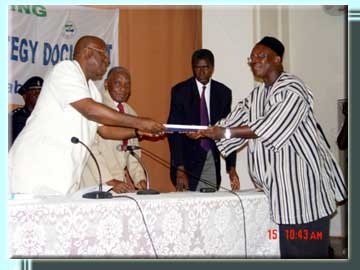
is with great pride and pleasure that I formally
launch the National Anti-Corruption Strategy (NACS).
=====================
-End-
|