|
KEYNOTE
ADDRESS BY HIS EXCELLENCY THE PRESIDENT
ALHAJI DR AHMAD TEJAN KABBAH
AT THE NATIONAL SYMPOSIUM ON THE THEME:
"FOUR YEARS OF FOOD SECURITY; LESSONS LEARNT
AND THE WAY FORWARD"
ON FRIDAY 19TH MAY 2006
-------------------------------------------------------
Mr
Chairman
Distinguished Ladies and Gentlemen:
Four
years ago today at the beginning of my second
term I launched my policy on food security, which
is a basic human right. The objective of this
policy is to ensure that every citizen has access
to food at all times. That commitment is consistent
with our strategy for job creation for our youths
and women and poverty reduction among rural communities.
Mr Chairman, when I made the pledge in May 2002
I was conscious of our endowments with adequate
land, water, good climate as well as abundant
human resource. I was also aware of the ability
of the women, men and youths of this country to
rise up to the challenge, once sensitised and
empowered to achieve household food security in
the short term and national food security in the
medium to long term. So after four years of this
journey together we ask; have Sierra Leoneans
risen to the challenge of food security? Will
we banish hunger from this nation by 2007? How
have we performed since 2002? Indeed what is the
status of food security today?
Mr
Chairman, food security, we all know, is about
adequate quantity for regular consumption, adequate
quality to ensure safety and proper nutrition
and adequate back up or safety nets in case of
natural or man-made disasters. It is also about
ensuring equity in access for every child, woman
and man and in an environment where all these
can be enjoyed. Therefore, Mr Chairman, right
from the beginning it was clear that if this pledge
was to be realized much was needed to be done
by all stakeholders including a change of our
attitudes.
For
this purpose, my Government with the support of
the international community started with the National
Recovery Strategy for 2002 - 2003 as a framework
for the implementation of our food security policy.
In this regard Government gave priority attention
to the restoration of the basic needs and services
including safe water, roads, communication, shelter,
primary education and basic health care. The foundation
was laid within the context of an improved national
security and good governance.
Mr
Chairman, ladies and gentlemen, in order to achieve
food self sufficiency within the specified timeframe
of five years we needed seeds, healthy livestock
and the commitment and know-how of men, women,
children and young Sierra Leoneans working hard
to sow, weed, protect and harvest the crop. We
also needed the private sector to invest in commercial
farming and the international community and NGOs
to provide the badly needed support for our efforts.
In
June 2002 the Food and Agricultural Organization
(FAO) of the United Nations fielded a mission
to Sierra Leone to study the agricultural sector
and identify the best approaches towards the attainment
of food security. The work of that mission resulted
in the Agricultural Sector Review document which
contains the most comprehensive state of the art
report on agriculture in Sierra Leone. Secondly
it supported the development of the Agricultural
Policy for Sierra Leone which is now in its final
stages of completion. Thirdly the FAO introduced
the Special Programme for Food Security which
we call "Operation Feed the Nation".
To conduct this special programme the experts
adopted the Farmer Field School System which stands
out as the most modern extension delivery system
currently. So far there are 767 Farmers Field
Schools involving 20,000 farmers to date.
The
FAO also helped to establish the Right to Food
Secretariat with funding support from the Government
of Germany. This Secretariat works as the food
security coordinating, monitoring and evaluation
umbrella agency to ensure the full participation
of all government ministries, the donor community,
non-governmental organisations and the private
sector to work together towards the realization
of the Right to Adequate Food for all the people
in Sierra Leone.
Mr
Chairman, the FAO is also supporting the School
Garden Programme which is presently being implemented
in 50 schools in three districts of Kambia, Kono
and Tonkolili. Presently a consultant has been
hired to develop curricular on food security to
be used by schools in the country.
My
Government wishes to convey its gratitude to the
FAO and all donors who are supporting activities
geared towards food security. The visit of the
Director General here last year to see for himself
the progress we are making in the implementation
of our food security policy is a gesture intended
to reassure us of FAO's firm commitment to our
cause for which we are thankful as a people.
I
am pleased to acknowledge with thanks the numerous
and varied interventions which have had a positive
impact. I also wish to recognise with appreciation
the role played by our development partners. As
a result of all these agricultural production
has increased considerably from 2002 to the present
time. The level of achievement in the production
of rice today is assessed at 69%. The production
of cassava was doubled while sweet potato production
also achieved very good results. I will be remiss
in my duty if I fail to highlight the positive
contribution of the Ministry of Agriculture and
Food Security in all of these achievements.
Mr.
Chairman, on our part, my Government has been
increasing the subventions to the Agriculture
and Food Security sector from 2.7% of the GDP
in 2002 to 5.6% in 2006. This figure goes to support
the requirements of the African Union that within
five years African countries should assign 10%
of their GDP to agriculture and rural development.
With this funding the Ministry of Agriculture
and Food Security has been steadily increasing
inputs to farmers in order to enable us attain
pre-war levels and then to improve our output.
For example government over the years has supplied
planting materials of seed rice, cassava, sweet
potatoes, maize and vegetables, fertilizers (up
to 2004) power tillers and tractors, rice threshers
and hullers, oil presses and mini mills; built
stores and drying floors and markets, all intended
to enhance productivity. Within the same period
government has supplied oil palm seedlings, cashew
nut seedlings and ginger to farmers throughout
the country to improve income generation by farmers
and strengthen export earnings from these crops.
Farmers
continue to benefit from the improved varieties
of rice, cassava, sweet potatoes and grain legumes
from the research institutions of this country
and regional and global institutions. Notable
among these are the NERICA varieties of rice being
disseminated by the Ministry of Agriculture and
Food Security and the Rice Research Station at
Rokupr with the support of the African Development
Bank and the Africa Rice Centre (WARDA); and the
improved cassava and potato varieties being released
by the Institute of Agricultural Research at Njala.
Mr
Chairman, I am pleased to note that through the
active support of the donor community and the
participation of the private sector the livestock
population has almost attained pre-war levels.
The challenge now is to sustain this gain and
in fact upscale it so that this sub sector could
play its rightful role in food security in the
future.
The
Ministry of Fisheries has also been assisting
artisanal fisher folk with inputs to increase
their catch which the majority of Sierra Leoneans
depend on.
Mr
Chairman, to complement our efforts, a number
of countries and agencies have provided the much
needed assistance over the years. In brief we
recall with gratitude the support of the Peoples
Republic of China in providing farm machinery,
in training several agricultural technicians.
China will shortly establish a technical team
in Sierra Leone for large-scale hybrid rice cultivation.
The team will be based initially at Rokupr.
The
Government of Iran has supplied us 69 tractors
to date while Libya has supplied 35 tractors and
some implements.
The
Government of Germany is supporting the sustainable
Seed Production Project in order to revive the
Seed Multiplication Project. So far they have
produced 500 Metric Tonnes of good quality seeds
after two years of work. Germany is also supporting
the Food Security project in Kono and Kailahun
Districts as well as the Right to Food Secretariat
in Freetown.
The Japanese International Cooperation Agency
(JICA) is about to launch the Kambia District
Agricultural Development Project, which targets
crop production with emphasis on post harvest
management, crop processing and value addition.
The Rice Research Station will provide technical
backstopping during project implementation.
Support
from the Government of Malaysia to the project
entitled "Capacity Building for Oil Palm
Production, Processing and Marketing" will
add value to oil palm products and improve the
earnings of farmers. The total project cost of
US$9 million will be provided as follows: Islamic
Development Bank $6 million, Malaysian Government
$2 million and the Government of Sierra Leone
$1 million. This project will be tailored after
the Federal Land Development Authority (FELDA)
Scheme of resettlement and job creation for the
rural communities. It is also designed to encourage
young people currently residing in urban areas
without jobs to relocate to these settlements
for gainful employment. This project will elaborate
upon the efforts of the Commonwealth Secretariat
in London which had provided funding for a pilot
project to establish six mini mills in the country
for oil palm processing and to supply 10,000 improved
oil palm seedlings to 50 cooperating farmers around
the country who were given basic training in oil
palm management.
We
also note with much appreciation the contribution
of the Government of Ireland in supporting the
Agricultural Business Units (ABUs), a project
being supervised by the UNDP and the Ministry
of Agriculture and Food Security.
So
far the Egyptian Government has trained a few
Sierra Leoneans in Egypt and sent two experts,
one in livestock and the other in irrigation to
work with the Ministry of Agriculture and Food
Security.
Recently two experts from the State of Israel
conducted the training of 40 Sierra Leoneans at
Levuma Beach, Waterloo in vegetable production
by drip irrigation methods.
The
United States Government and the European Community
are also very supportive of the Food Security
Programme making their interventions through NGOs.
Presently
the European Community (EC) approved Euros 4.5
million Stabex funds for the rehabilitation of
tree crops in the country.
The
National Association of Farmers of Sierra Leone
and the NGO Community are playing very vital roles
towards the food security programme. The Government
appreciates these efforts.
Mr
Chairman, I will also like to recognize the increasing
support of the multilateral donor banks. For instance
IFAD and the ADB are jointly funding a $30 million
agriculture and rural development project to cover
seven districts of Kono, Kailahun, Kenema, Pujehun,
Moyamba, Port Loko and Kambia. The Islamic Development
Bank has approved $11 million for the Diversified
Food Production project to cover Bo, Tonkolili
and Bombali. The Malaysia Oil Palm Project will
be located in the Provincial Headquarters and
in the Western Area.
For
Koinadugu District there are frantic efforts to
develop a livestock rehabilitation and development
project to be funded by the IDB.
The
World Bank is actively engaged in the formulation
of a Rural and Private Sector Development Project
to strengthen the private sector and promote the
marketing of agricultural products in order to
maximize returns from farming. The amount involved
is $28 million.
Mr
Chairman, as a way to establish a healthy and
stable macro-economic environment for food security,
my government continues to construct new road
networks, markets and stores, to improve upon
water and sanitation and to construct multiple
health centres throughout the country. We are
constantly improving on all aspects of good governance,
the rule of law and human rights.
We
are also engaged with other development partners
to improve the energy and telecommunication sectors
of the economy and we are making encouraging strides
in these areas.
Mr.
Chairman, job creation especially for the youth
of this country is at the heart of the PRSP Programme
and therefore a priority for this government.
In this regard, I am pleased to acknowledge the
rehabilitation and development of the Magbass
Sugar Company in Magburaka which has employed
up to 1500 workers. Magbass has just exported
to Europe 5,800 metric tonnes of sugar, which
will bring in the much needed foreign exchange.
In fact the country's foreign exchange base has
started to increase with the export of about 500
metric tonnes of cashew nuts and 40 metric tonnes
of ginger per year for a start.
Government
has set up the National Security Agency which
manages disasters. Of special note is the Avian
Influenza Pandemic which government has moved
very fast to put necessary measures for prevention
and control.
Therefore,
Mr Chairman, ladies and gentlemen this account
of our efforts as a government together with donor
partners have contributed immensely to the good
results we have so far secured in the food security
programme. But this is not enough. We have to
sustain these gains and improve upon them to make
food security a basic human right.
So
for the way forward my government will continue
to seek creative strategies for the Right to Food
Secretariat (RTFS) to become fully operational
in supporting the Ministerial Committee under
the chairmanship of the Vice President. With the
support of FAO, Government has put in place the
following modalities:
"
Setting up of District Food Security Committees
to coordinate, monitoring and evaluation of agricultural
services at the District level;
" Embarked on the development of an effective
communication strategy to build an information
infrastructure that will reach all the different
stakeholder groups in the agriculture industry;
" Undertake a legal review of right to food
security issues by examining the Constitution
of Sierra Leone Act No.6 of 1991 and other laws
to ensure that there is explicit provision for
food as a human right in Sierra Leone.
For
the immediate future there is the Cassava Initiative
which I established recently to develop this crop
as an important industrial/poverty alleviation
crop in Sierra Leone. The Task Force charged with
responsibility for this initiative is working
hard to develop proposals for funding and organize
stakeholders for production, processing and marketing
of the products. The Chinese Government has expressed
interest in cooperating with my Government for
cassava production, processing and possible export
to China. The details of this project will be
made public in due course. Meanwhile Sierra Leoneans
who are interested in this project may contact
the Cassava Initiative Task Force in the Ministry
of Agriculture and Food Security.
The
HIV/AIDS scourge still poses a major limiting
factor to agricultural productivity. While government
continues to improve the health status of Sierra
Leoneans it will continue to sustain the high
premium attention on this disease as a way to
control its spread among the people.
Finally
Mr Chairman, ladies and gentlemen let me invite
all well meaning Sierra Leoneans and our development
partners to continue to support the food security
programme until the battle against hunger is won
for now and for future generation.
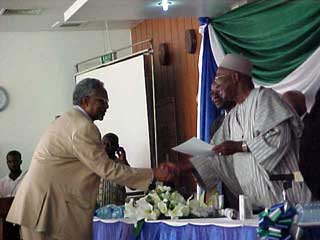
For
now as a token appreciation of persons and agencies
which have contributed to Food Security I am going
to present certificates of recognition to them
during this ceremony. I hope by this gesture more
and more Sierra Leoneans will double their efforts
so that they can also be recognised.
I
thank you for your attention and I now declare
this National Symposium on Food Security open.
**********************************
|