New
Digital Exchanges Telephone Lines For Bo, Kenema
And Lungi
By Yusuf Alghali
President
Ahmad Tejan Kabbah has made public his displeasure
about the non-performance over the past years
of the board and management of the Sierra Leone
Telecommunications Company (Sierratel), charging
that corporate financial malpractices had even
made it impossible for the company to pay dividends
to government since he became President in 1996.
Speaking
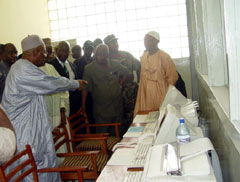
at the commissioning ceremony of the new Sierratel
digital telephone exchange in Bo Saturday 3rd
April 2004, the President stated that in normal
competitive private market conditions, such
an adverse situation would be a recipe for a
take-over bid, resulting in the company's new
owners dismissing the non-performing management.
However, as a first step, he said, government
in consultation with the National Commission
for Privatisation (NCP), had "injected
some fresh blood into the Board with a view
to bolstering its strength and thereby restructuring
and streamlining the management of the company".
Continuing,
the President made clear his government's recognition
of the significance of the telecommunications
industry both as an engine of growth and a vehicle
for the transfer of information. He said this
recognition had led to the formulation of a
policy for the rehabilitation of Sierratel's
fixed line services as far back as 2000, with
the hope of facilitating the introduction of
competitive cellular, mobile telephone services.
"But soon afterwards government realised
that Sierratel was incapable, both managerially
and financially, to achieve the objectives of
that policy for the modernisation of the telecommunications
industry," the President went on, adding
that the only option then open to it was to
privatise the company and introduce a new Telecommunications
Act.
He
recalled that government had sought help from
the International Finance Corporation of the
World Bank for the process of privatising Sierratel
but explained that the transaction itself collapsed
in 2002 when Spectronics, one of the key potential
investors for Sierratel, pulled out of the bidding
process.
The
Head of State, who also made reference to what
he called "the lack of financial prudence
and disharmony at both the Board and Management
levels", said such had resulted in Sierratel
being unable to meet the challenges to its market
share by local cell phone operators - Celtel
and Millicom - who now together have about 100,000
subscribers as opposed to Sierratel's 23,000.
He maintained that financial and other irregularities
in the company, brought to his attention during
the course of last year, could have been contained
if there was unity at both Board and Management
levels, a point also echoed by the NCP chairman,
Mr. A. R. Turay, who earlier decried the lack
of corporate culture in many local parastatals.
In
this connection however, the President urged
the current management of Sierratel to adopt
measures attractive to "serious external
investors who could bring into the company both
new money and modern technology". At the
same time, he spurred the Ministry of Transport
and Communications as well as the National Commission
for Privatisation to expedite the enactment
of the draft Telecommunications Bill, which
is expected to restore public confidence and
orderly competition in the industry. The President
was hopeful the new measures would put a check
to the current exorbitant increases in cellular
mobile telephone charges.
Saturday's
commissioning of the new digital telephone switch
board in Bo will soon see the replacement of
a total of 1300 lines of old electro-mechanical
switches in Bo, Kenema and Lungi that were installed
over thirty five years ago, with a four-fold
increase in digital lines totalling 5,000. This
new facility will make it possible for calls
to be made from Bo, Kenema and Lungi by International
Direct Dialling (IDD) worldwide and within the
country. Internet access is also now possible
to large databases globally from these three
localities in Sierra Leone. In addition, telephone
services have been restored at Rotifunk and
Moyamba and will be followed by the refurbishment
of microwave radio stations that were destroyed
during the rebel war in Segbwema, Landofeh mountains,
Koidu, Port Loko, Lunsar and Makeni. This, Sierratel
official sources say, is to be followed by the
installation of digital systems before the end
of 2004.
In
his statements earlier, Sierratel's Board Chairman
Abu Aiah Koroma informed his audience about
ongoing collaborative arrangements with Ericsson
of Sweden, to include in its operations a mobile
phone service and wireless land phone facilities
that could be installed in remote rural communities
with minimum infrastructural development.
"The
successful implementation of this project will
be a test of the renewed commitment of the Board
and Management to raise the level of performance
of Sierratel and prepare the company for meeting
the challenges it now faces in a highly competitive
environment," President Kabbah told a large
crowd of Bo residents and Sierratel employees,
who witnessed the official commissioning of
the new digital facility.
-End-


