Sababu
Education Project Pays Fees and Donates Books,
Uniforms In Kenema.n
By Marian Samu
Girls
of Sierra Leone have since the introduction
of Western education in the country trailed
behind boys in terms of access to and retention
in school. The dropout and the low enrolment
rates of girls have been largely blamed on parents'
failure to provide for girls' education. Due
to the high incidence of poverty in the country,
most families in the rural areas preferred to
let their boy children stay in school because
of meagre resources, while the girl children
are often left at home to assist in domestic
chores and later to be given out in marriage.
This situation had resulted in the very low
percentage of educated women as compared to
men in the country, and to the overall low literacy
statistic in the country.
In
a bid to reverse this situation, government
has embarked on thefunding of girls' education
through the Sababu Education Project. Due to
the very low rate of girl's enrolment and retention
in schools in the Eastern and Northern regions
in particular, government had selected those
areas for the first phase of the project implementation,
which involves the payment of school fees, donation
of books and other relevant school materials
in respect of girls who pass the National Primary
School Examination (NPSE), until they complete
the first three years of junior secondary school
or JSS3.
The
President, Alhaji Dr. Ahmad Tejan Kabbah, was
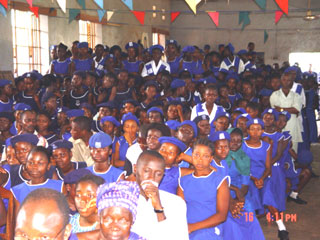
in Kenema to officiate at the 2004 Sababu Education
Project Implementation in Kenema, Eastern Sierra
Leone, at an impressive and colourful ceremony
held at the Holy Rosary Secondary School hall.
Each girl child in Junior Secondary School is
entitled to receive textbooks, pens, pencils,
rulers, a geometry set, exercise books and two
pairs of uniforms including her school fees
for the year.
Welcoming
guests to the ceremony, the Resident Minister,
East, Hon. Sahr Randolph Fillie-Faboe, said
this is the first time in the history of Sierra
Leone for a government to pay not only school
fees for all the school going girls in Junior
Secondary School, but also provide books and
other school materials including uniforms. He
called on the parents to ensure that their girl-children
are sent to school and advised the school children
to make the best use of the opportunity.
The
Acting Director of the project, Dr. Chuku Dupiny,
informed his audience that all funds for the
project are provided by government through a
World Bank loan, and that both local and International
ngos have been engaged as partners to help implement
the project. The Sababu Education Project, Dr.
Dupiny said, also includes the construction
of schools in areas where there are no schools
or not enough schools to serve the locality
or chiefdom, and to build at least one junior
secondary school in every chiefdom throughout
the country.
Dr.
Dupiny also stated that they at the project
coordinating unit are aware of the fact that
the nation has entrusted them with a responsibility
that is beyond the US$40 million value of the
project because the nation has entrusted them
with the education of its children, and therefore,
the future of the nation. He pledged on behalf
of his team to do all within their powers to
ensure that the project is not only successful
in meeting all of its goals, but that it is
transparent and fully accountable to all.
Mr.
Jacob Saffa, the Acting Manager of the World
Bank Sierra Leone Country office, observed that
the launching of the project by President Kabbah
himself is a sign of his commitment to girls'
education in the country. He noted that the
Sababu Project is a means of building capacity
for the government under the education recovery
programme.
The
Minister of Education, Science and Technology,
Dr. Alpha Wurie, explained that out of the US$40
million for the Sababu Education Project, $13
million will be spent for the eastern region
alone. He said they have already identified
fourteen sites for the building of schools in
the Kenema district alone. He reiterated the
fact that all the school materials for the project
are being bought by the government of Sierra
Leone and emphasized that government is spending
money on education because of the faith they
have in the children of Sierra Leone. Dr. Wurie
informed his audience that by 2006 a total of
eighty-five schools will have been built in
the eastern region and every chiefdom in the
country will have at least one Junior Secondary
School.
Minister
Wurie expressed great satisfaction that the
children in the eastern region did very well
in the last National Primary School Examination
and the West African School Certificate Examination.
He advised them to keep working hard and come
out with even better results in the subsequent
examinations.
The
President, Alhaji Dr. Ahmad Tejan Kabbah, praised
Dr. Alpha Wurie and his colleagues at the Ministry
of Education, Science and Technology for undertaking
the Sababu Education Project, which he described
as a noble venture.
President
Kabbah said the children will have to take over
from the adults, and that parents count on their
children and regard them as security for their
old age. To have the children as security, the
President said, we must be able to provide them
with the necessary education. He said "Sababu"
is a cross-ethnic word in Sierra Leone, meaning
'opportunity', and that all Sierra Leoneans
must be provided with this opportunity.
He
cautioned parents, who because of lack of resources
to pay school fees for their children, particularly
the girl child, marry them off, making them
incapable of using their intelligence for their
own development and consequently the development
of the country. He said parents no longer have
an excuse. He obliged them to ensure that they
send their girl child to school.
President
Kabbah also advised the children to be good
members of their families and communities, and
be obedient to their parents, and not to use
their education to become disrespectful to their
parents.
-End-