Private
Sector Development Forum Opens In Freetown
By Marian Samu
The
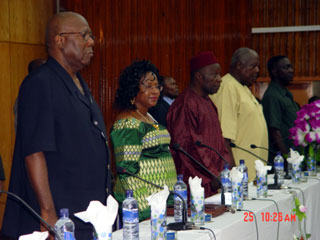
President, Alhaji Dr. Ahmad Tejan Kabbah, on
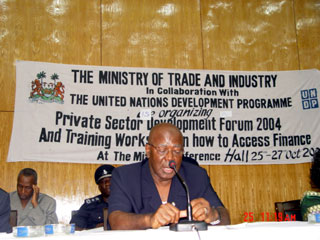
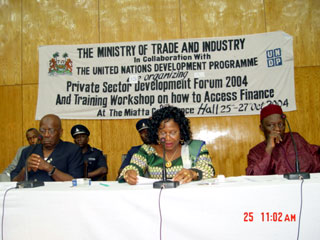
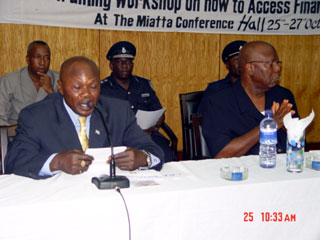
Monday 25th October, 2004 opened the 2004 Private
Sector Development Forum at the Miatta Conference
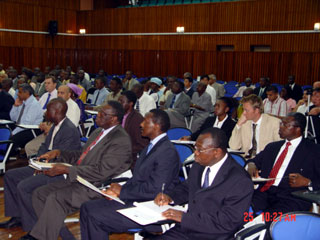
Centre in Freetown. The event attracted representatives
of the private sector, entrepreneurs and financing
institutions, both local and international.
Welcoming
guests and participants at the opening ceremony
the Governor of the Bank of Sierra Leone, Dr.
James Rogers, who chaired the occasion, said
the forum is quite appropriate and timely, particularly
at this time of the country's recovery process.
He said the forum was organized to bring all
the players together to deliberate on the concept,
policies, programmes and strategies for the
private sector to play its key role of harnessing
and distributing financial and other resources
to facilitate growth, wealth and job creation.
Dr.
Rogers stated that government fully recognizes
private sector investment to be the leading
stimulus for economic growth and development,
but contrastingly, while the GDP has grown steadily
from 3.8% in 2002 to 9.4% in 2003, which is
reflective of robust economic activity, private
sector investment rose only marginally from
1.3% of GDP in 2001 to 1.7% of GDP in 2002.
This, the Governor said, compares unfavourably
with public sector investment, which rose from
4.8% of GDP in 2001 to 5.3% in 2002. He, however,
expressed belief that this forum would address
these and other key issues in private sector
development.
The
European Union Trade Expert, Mr. Trevor Simumba,
while giving a brief background to the forum
said he was amazed at the kind of development
that has taken place in such a short time after
the end of the war in January, 2002. He said
he was proud to be in Sierra Leone at this period
and be part of the process.
Mr.
Simumba said he has been working with the Ministry
of Trade and Industry for the last few months
to put in place a policy framework for business
enterprise development in Sierra Leone, and
that the forum is an outcome of such work which
was made possible with support from the United
Nations Development Programme (UNDP). He said
an extensive mixed group of both national and
international organizations will participate
in the forum, including the European Investment
Bank, ACP, Pro-Invest, ECOWAS Bank, the International
Finance Corporation of the World Bank, UNIDO,
Action Aid, Association of Sierra Leone Commercial
Banks, Sierra Leone Indigenous Business Association,
etc.
Mr.
Ibrahim S. Kamara, UNDP Poverty Programme Specialist,
said that there has been persistent calls for
the development of the private sector to propel
the growth of the least developed and vulnerable
economies such as Sierra Leone. He noted that
no matter how committed the public sector may
be towards promoting appreciable levels of economic
growth, it will ever remain an illusion since
Government, the prime mover of the public sector,
cannot do business based on sound economic and
commercial principles. The Sierra Leone government,
he said, like most other responsible governments
has ever since acknowledged the efficacy of
passing over this responsibility to the private
sector, even against a number of odds. He stated
that among the numerous factors responsible
for the underdevelopment of the private sector
in Sierra Leone is the perennial problem of
inadequate opportunities for financing business.
Mr.
Kamara, however, said that UNDP will contribute
towards private sector leadership through capacity-building
and entrepreneurial skills training to small
and medium scale enterprises, focusing on women
and youth-run businesses. He said they, in essence,
will promote grassroots financing, particularly
for the majority of the rural poor. Mr. Kamara
also sent out a strong message of the need to
open up for direct foreign investment.
The
Minister of Trade and Industry, Dr. Kadi Sesay,
said that the promotion of private sector development
is crucial, particularly the small and medium
scale businesses and that is why they have organised
this forum and brought together national and
international financing institutions and business
enterprises to address the issue.
Dr. Kadi Sesay said that in collaboration with
the World Bank they have been able to develop
the Investment Promotion Code, a document for
developing business in Sierra Leone.
Talking
about the various efforts her Ministry has made
in this direction, Dr. Sesay mentioned, inter
alia, the development of an Action Plan for
dismantling administrative barriers that prevent
the private sector from accessing finances,
the development of the garments and textiles
promotion trade, development of SLEDIC and the
transformation of the National Workshop at Cline
Town into an industrial estate, which is currently
being rehabilitated by the Chinese. The Minister
also informed her audience that Sierra Leone
has been given access into the AGOA visa arrangement
for our textiles and garments to be exported
to the United States, adding that discussions
have already been held with business enterprises
in the U.S. A. and that so far, orders have
been placed which are being processed.
Dr.
Kadi Sesay, however, lamented that in spite
of efforts being made by small and medium scale
businesses to expand, financing is still a big
bottleneck for them. She cited the ECOWAS Bank
as one institution from which no Sierra Leonean
has yet benefited.
She
also spoke about the OPEC Fund and the OPEC
Investment Scheme and said Sierra Leone has
signed an agreement with OPEC, so business enterprises
can now approach them for help.
She
appealed to all financial institutions for a
fruitful one-to-one discussion with business
enterprises so as to come up with good recommendations
to help move the private sector forward.
The President, Alhaji Dr. Ahmad Tejan Kabbah,
said he was happy that the Ministry of Trade
and Industry, together with donor partners has
organized the Forum to exchange ideas on how
finance, a major constraint for business promotion
and indeed economic growth, can be made more
accessible. President Kabbah stated that the
inability of our businesses to access finance
either because of unavailability or cost has
been a matter of great concern to him. Consequently,
he said he had requested the State-owned commercial
banks during the last two occasions when they
presented dividends to government, and during
the last annual dinner of the Sierra Leone Chamber
of Commerce, that they design lending policies
and instruments to make finance less costly
and more accessible to a wider business community,
including farmers.
He
noted Sierra Leone has achieved considerable
progress in economic, political and social recovery
since the end of the civil war, and that it
has now embarked on economic policies aimed
at sustainable economic growth and development.
The private sector, he observed, plays a key
role in this strategy. President Kabbah emphasised
the need to remove both fiscal and financial
constraints that could impede development, adding
that government has already put in place fiscal
policies to promote foreign direct investment-
the investment code. He said it is now for this
Forum to come up with policy recommendations
aimed at removing the present financial constraints
on capital formation in the private sector,
especially for Sierra Leonean entrepreneurs.
President
Kabbah also gave assurance of Government's determination
to provide a policy environment that will facilitate
private sector development, but noted that the
lack of capacity to do this effectively is constrained
severely by both financial and human resource
gaps.
Talking about the important role of the banking
and financial institutions, President Kabbah
noted the presence of new entrants, like the
International Commercial Bank (Sierra Leone)
Ltd. from Malaysia and the establishment of
community banks countrywide by the Bank of Sierra
Leone, in an attempt to bring financial intermediation
to the doorsteps of the disadvantaged population
in the rural communities.
It
is expected that these initiatives, coupled
with more innovative policies and strategies
to engage the private sector will provide the
fuel for the private sector to play its role
as an engine of growth of the economy.
President
Kabbah, however, expressed concern that access
to medium and long-term capital at affordable
cost is difficult and in most cases non-existent,
particularly, for Small and Medium Scale Enterprises
(SMES), noting that growth and the creation
of employment would come largely from a vibrant,
well-resourced and competitive small and medium
level enterprises.
He therefore appealed to all the financial institutions
present to promote the establishment of private
sector development financing schemes that can
provide the financial resources required for
our local entrepreneurs to access and develop
their businesses further.
-End-