President
Kabbah Opens Goderich Secondary School, MMCET
Lecture Rooms
By Yusuf
Alghali
10th
October 2003-"Our chance to succeed
as a country lies in giving our people hope,
faith and exposure to sustainable skills,"
President Ahmad Tejan Kabbah said Friday,
while addressing an assembly of educational
stakeholders at the Goderich community some
nine miles outside central Freetown.
It
was a triple occasion for the President, which
included his formal opening of The Lady Patricia
Kabbah Memorial Junior Secondary School, the
practising school for teachers undergoing training
at the MMCET; the opening of six new lecture
rooms at the nearby Milton Margai College of
Education and Technology (MMCET) Goderich Campus,
as well as the presentation of a 30-seater bus
to the MMCET Polytechnic students' Union.
Speaking
at the opening, renaming and dedication ceremony
of the junior secondary school, named in honour
of his late spouse, Lady Patricia Lucy Kabbah,
the President noted that "educating our
people to serve in various capacities continues
to be a major priority objective".
He
made reference to the recently published public
examination results, which he noted, have begun
to show improvement in
quality. However, he also pointed out that "for
increased quality output for a large number
of students, the facilities must be improved".
The
Head of State went on to observe that after
a long period of neglect and destruction, the
Lady Patricia Kabbah Junior Secondary School
was the first new secondary school to be built
by government in Freetown in thirty years. He
also made it clear that he did not in any way
influence the renaming of the school but thanked
the organisers for what he called "such
well deserved posthumous honour".
He
recalled that his late wife was first and foremost
an educator who also focused mainly on the education
of the girl child, for which a trust fund now
operates under her name. Some fifty girl-children
across the country are currently benefiting
from support provided through the Patricia Kabbah
Memorial Scholarship Trust Fu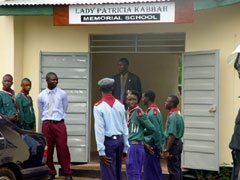 nd.
nd.
The
President, who cautioned against converting
the school to private use, also expressed the
hope that the institution would serve the children
of Goderich as well as the neighbouring Lumley
to Hamilton communities.
In
an earlier statement, Principal, Mrs Eugenia
L. Johnson, hoped that the school would meet
the aims and objectives of the dear departed
Lady Patricia Kabbah in whose memory the school
is renamed, for her relentless efforts in promoting
education, especially for the girl child. She
wished Mrs Kabbah had lived longer to see some
of her aspirations and desires come to fruition.
Chairman
of the occasion, MMCET Principal, Dr. Denis
Kargbo, said the school itself is a new development
in the history of Milton Margai Teachers College,
itself renamed a fewyears ago to Milton Margai
College of Education and most recently to Milton
Margai College of Education and Technology.
He said the rationale behind the establishment
of the school was to have
a teacher training facility for the professional
practice of trainees of the MMCET. He likened
the previous situation to one where one trains
surgeons in the medical field without a surgery
for their practice.
He
expressed his thanks to government and other benevolent
development partners who made "this much-needed
and much-appreciated addition to the MMCET practising
school". However Dr. Kargbo disclosed that
they at the MMCET were under pressure from the
community to establish a senior secondary school
section in the school. He said: "The college
is already producing teachers at degree level
who are teaching in Senior Secondary Schools nationwide.
So we are more than prepared to meet the challenge
of producing qualified teachers for the Senior
Secondary School level of this schoolboth for
internship and for paid work."
Other
speakers at the event included Ms. Evelyn Williams,
President of Sisters Unite, a social organisation
of which the late First Lady was founder member.
Ms. Williams recognised
that Mrs Kabbah was the very First Lady to have
visited schools, both primary and secondary,
immediately after she became First Lady.
"It
was during such visits that she showed great
concern for children's welfare especially of
the deplorable conditions of some schools. I
can clearly remember how she almost wept when
we visited one school on a wet day and found
the children sitting on stones, with pools of
water in the middle of all the classrooms. She
was so moved that she immediately made her requests
for such schools to be rehabilitated. I am pleased
to say that her dreams had come true and all
the schools visited, which were in bad shape,
have now been rehabilitated and converted into
modern permanent structures with proper furniture
instead of stones," said Ms. Williams.
She
added therefore that
"it is indeed most fitting and in place,
to rename a Junior Secondary School after her,
in memory of her interest demonstrated in education,
and as a role model for all of us, especially
the girl child."
Following
that event, President Kabbah proceeded to formally
launch the six new lecture rooms located close
to the picturesque ocean view of the nearby
Milton Margai College of Education and Technology.
Addressing
a large crowd of college students and staff
at the site of the new structures, President
Kabbah disclosed that every year government
allocates development funds to some tertiary
institutions. He explained that the buildings
were put up using the 2001 development funds
provided by government, adding that the enactment
of the Polytechnic Act now sees MMCET offering
several new Teaching Courses as well.
The
President went on to note that as the number
of tertiary students steadily increases, not
all could stay in the limited available hostels.
He said the provision of a bus for students
generally was conceived by government as a means
of enhancing access and timeliness for lectures,
noting that a similar practice obtained today
in virtually all tertiary institutions in the
developed world, where thousands of students
commute daily from their respective places of
abode to attend lectures.
He
indicated that the management and ownership
of the bus would be entrusted to the students
and that the idea was borne out of government's
desire to provide practical training grounds
with such responsibilities that would prepare
them well for their future roles in society.
"Students
are therefore expected to utilize the bus well
on a cost recovery basis so
that in a matter of time, they would be able
to procure another bus or buses to serve them,"
President Kabbah said, but added that in the
same vein, government in providing the buses,
aims at injecting a spirit of healthy competition
amongst students of our tertiary institutions,
such that the possibility might be considered
only for those who manage their bus programmes
well to be subsidized in the future to procure
another. He said government would therefore
not be responsible for any repairs, fuel cost,
tyre replacement and any other costs related
to the running of the buses.
-End-


