President
Kabbah Launches National Social Action Project
By Yusuf Alghali
In
furtherance of his government's efforts to reduce
the risk of renewed conflict and lay the foundation
for poverty reduction, improved health and education,
as well as target the rural population, President
Ahmad Tejan Kabbah today launched the National
Social Action Project (NSAP), an offshoot of
the National Commission for Social Action (NaCSA).
President's Speech
NSAP
is a funding window jointly supported by the
government of Sierra Leone and the World Bank
to "assist war-affected communities restore
social services and infrastructure as well as
build local capacity for collective action".
However, according to the project's objective,
priority will be given to areas not previously
serviced by government, newly accessible and
most vulnerable population groups within those
regions.
Addressing
his audience at the Kingtom Bank Complex prior
to his formal launching of the project, President
Kabbah recalled that NaCSA and its predecessor,
the National Commission for Reconstruction,
Resettlement and Rehabilitation (NCRRR), had
so far undertaken over seven hundred projects
geared towards a rapid transition from post
war relief to economic growth and sustainable
development, leading to poverty reduction. He
also pointed out that the projects were "successfully
implemented with the invaluable assistance of
our development partners", because they
"recognise the contribution…that we
have made and continue to make to our own national
recovery and development".
The
President added: "We should take pride
in the fact that despite the enormous and
complex problems associated with the critical
transition from post-war relief to sustainable
development, seventy per cent of the projects
in the priority areas have been completed, noting
that there is "absolutely no reason to
doubt the confidence our development partners
have in our ability to assume greater responsibility
for our own development programme".
The
projects cover key sub-sectors, reflecting the
priority areas of intervention identified in
our National Recovery Strategy, namely: agriculture,
health, education, community infrastructure,
micro-finance enterprise promotion, resettlement
and rehabilitation, shelter and information
and sensitisation
President
Kabbah said that in fulfillment of his administration's
firm commitment to empowering rural communities
through decentralisation, participation and
good governance, the National Social Action
Project, which he described as an instrument
of peace and national development, would be
launched next week, at the regional level, in
Bo, Makeni and Kenema.
He
said this was also another means of "mobilizing
public support for and involvement in ensuring
peace and stability through economic and social
development", while at the same time "empowering
local communities to participate actively in
the reconstruction and rehabilitation process".
Likening
the situation of post war Sierra Leone to that
of Europe after the Second World War, the Head
of State said "the requirements of Europe
were 'so much greater than her post-war ability
to pay that she must have substantial additional
help or face economic, social and political
deterioration of very grave character".
However, he was thankful to the generosity of
Sierra Leone's development partners, which,
coupled with the determination of the government
and people of this country, were forging ahead
with the limited resources available for post-war
rehabilitation, reconstruction and recovery.
But the President went on to emphasise that
it was his government's "determination
is to work hard and build up wealth to enable
us to reduce our dependence on foreign aid".
"This policy has not changed," he
said, calling on his compatriots to help in
the achievement of this objective by, for example,
cooperating fully with the newly established
National Revenue Authority (NRA) and refrain
from discouraging those who are trying to get
it started and established on a sound foundation.
He
said recent history had taught all that post-war
reconstruction in any country, including European
countries that were already developed, is a
very expensive and complex undertaking. The
President observed that the destruction caused
by the ten-year rebel war was so massive and
extensive that it would take some time to attain
pre-war levels in many aspects of our national
life. Government and various interested partners
have determined that some 300,000 towns and
villages, 340,000 houses, 287 court barays,
2000 educational facilities, 2000 health facilities,
5000 water wells, and other infrastructure were
destroyed throughout the country. This is in
addition to vast acreages of agricultural crops
and livestock destroyed. Police stations, prisons,
law courts and other social and economic facilities
were not spared the widespread damages. Naturally,
he added, these caused large numbers of displaceme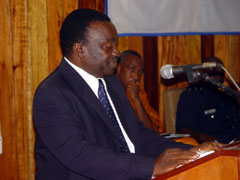 nt
of people both internally and externally.
nt
of people both internally and externally.
Such
facts and figures, President Kabbah continued,
could be overwhelming even for more developed
countries which are also engaged in post-war
reconstruction. He said these were the objective
realities prevailing in the country, which must
not be ignored when assessing the state of Sierra
Leone's reconstruction and recovery programme.
"Let
me re-echo my commitment that one by one, we
shall not only rehabilitate and refurbish, but
we shall also, where appropriate, rebuild every
single structure and every institution in this
country that has been damaged by the rebel war
by accident or by sheer human neglect.
"This
is not just a promise. It is a challenge, a
challenge that we must all accept in the interest
of our real peace and sustainable development
of our beloved country. The increased confidence
demonstrated by donors for our efforts continue
to encourage us to work even harder to achieve
our final goal of not only reconstructing and
rehabilitating but also building solid structures
on which the future of our country depends."
Earlier
in his statements, NaCSA chief Alhaji Kanja
Sesay indicated that the social fund approach
now being pursued was designed to help build
human and technical capacity rapidly in one
government entity. He said it could also provide
effective assistance in multiple sectors in
a post-conflict environment such as Sierra Leone's
in which every fabric of society was affected.
"This way", he added, "it would
help to re-establish governance in large parts
of the country and support in poverty alleviation."
Through
the World Bank financed Emergency Recovery Support
Fund (ERSF), which preceded the NSAP launched
today, NaCSA funded 269 or 37% of the total
727
sub-projects implemented so far. The other major
partners complimenting Government's efforts
in NaCSA are the African Development Bank, Islamic
Development Bank, UNDP, UNHCR, DFID and the
Government of France.
The
major component of the National Social Action
Project is the Community-Driven Program (CDP),
which will directly finance communities to establish
their priorities, select sub-projects and assume
responsibility
for managing, implementing, and maintaining
sub projects. The CDP, according to Kanja Sesay,
will finance at least 1,000 social and economic
infrastructure sub-projects and support social
capital building activities to facilitate the
restoration of basic social services, particularly
in health and education. It will also provide
an incentive for teachers, health workers and
displaced persons to return to their communities,
through the provision of basic staff quarters
for the schools and health units.
The
NaCSA boss also disclosed that the pilot rural
public works and shelter programs would provide
employment for youths, demobilized soldiers,
housing for displaced persons and community
roads to stimulate local economic activities.
He said temporary employment would be created
through the reconstruction and upgrading of
100 kilometers of critical community roads to
increase access of farmers to market, thereby
promoting food security, while, 1,700 housing
units would be built for the most vulnerable
groups, including female-headed households,
the handicapped and war-wounded. These shelter
and feeder roads projects will be piloted only
in the three least serviced areas under NaCSA's
previous programmes
- Koinadugu, Kailahun and Kono. The project
also makes provision for innovative activities,
including training and technical support.
Mr.
Sesay also revealed that his commission was
now finalizing the recruitment of NGOs for community
mobilization and facilitation country-wide and
for the shelter pilot projects covering Koinadugu,
Kono and Kailahun districts.
Specifically,
he said NaCSA would be funding sub-projects
in agriculture, including grain stores, drying
floors and post-harvest technologies; primary
schools and functional literacy; primary health
units, water wells and latrines, community centres,
community roads, markets and bridges. "The
beneficiary communities, in particular, will
be involved in the identification, selection,
and implementation of community-based projects,"
he stressed,
adding that capacity building activities for
regional and local government authorities and
community members would involve beneficiaries
in all stages of the rehabilitation and reconstruction
process. The projects, which will be implemented
under the NSAP in the next five years therefore,
are geared towards achieving a more prosperous,
stable and peaceful Sierra Leone.
Also
in his remarks, World Bank Country Director
Matts Karlsson told his audience that "the
bank's vision for NaCSA in 2008 when this project
will close, is that all local government structures
have benefited from capacity building efforts
and that they are at the forefront of community
driven development in Sierra Leone." He
said with this new approach of direct community
financing, the World Bank was "confident
that communities will be challenged and will
do things for themselves".
-End-


