President
Kabbah Visits Newly Rehabilitated Palm Kernel
Oil Mill.
By Marian Samu
30th
August 2004: The 1980s are remembered in
Sierra Leone as the period that economic decline
got to its highest. The close of the 1980s witnessed
an unprecedented period for the downward trend
of most public enterprises and parastatals,
while some even came to a complete inertia.
One
of the areas that was badly hit by this scenario
was the Sierra Leone Produce Marketing Board
and its subsidiary establishments, the Palm
Kernel Oil Mill and oil palm plantations in
the south and east of the country.
As
Government intensifies its efforts to revitalize
some of these defunct enterprises through its
privatisation programme, the Palm Kernel Oil
Mill at Wellington is one of such enterprises
that has gone through the privatisation initiatives
of government.
The
Palm Kernel Oil Mill first went through the
privatisation process in 1994 during the NPRC
Military government, when an indigenous Sierra
Leonean Company, APMC, won the tender for the
mill for five hundred and forty-four thousand
U.S. dollars. APMC paid an initial sum of one
hundred and thirty-five thousand dollars and
started rehabilitation of the mill.
The
AFRC coup in 1997 brought the rehabilitation
of the mill to a halt. After the return of the
democratically elected government, the APMC
found out that the mill had been completely
vandalised and they were unable to recommence
work due to the huge cost involved to continue
rehabilitation work on the mill.
The
inability of APMC to recommence work at the
P.K. Oil Mill made government to turn to another
indigenous Sierra Leonean Company, the MARIKA
Enterprises, which had earlier shown interest
to take over the mill, with an agreement that
MARIKA Enterprises refund to APMC the amount
of $135,000 that had already been paid to government
and to pay in full the remaining balance of
the amount specified in the tender.
The
MARIKA Enterprises has almost completed rehabilitation
work, with machines imported and already installed.
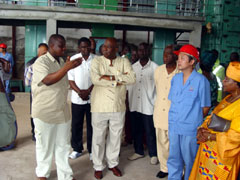
President Ahmad Tejan Kabbah, over the weekend,
paid a visit to the mill and was taken on a
conducted tour of the nearly completed rehabilitated
Palm Kernel Oil Mill.
On
arrival at the mill, President Kabbah was received
by the Managing Director of MARIKA Enterprises,
Mr. Sahid Koroma and a team of Chinese Engineers.
Mr. Koroma, together with the head of the Chinese
engineering team, escorted the President on
a tour of the mill, explaining to him the various
processing points, from the crushing of the
kernel to purification and separation, de-colourizing,
de-odourizing and to the cooling point from
where the final product of vegetable oil is
collected.
Mr.
Sahid Koroma told the President that the milling
machines have the capacity to crush up 50 tons
of palm kernel per day, (i.e. one thousand of
50 kilogram bags per day), and will produce
about 20 tons of oil or 5,500 gallons per day.
With this rate of production and since Sierra
Leone could consume only about 20 tons of oil
per month, Mr. Koroma said that they have explored
the possibility of exporting the surplus, starting
with our close neighbours in the West African
sub-region. Mr. Koroma said the domestic market
will have enough supply that will force the
prize of vegetable oil down. He further explained
that they will also be engaged in the production
of other non-edible products like laundry soap,
toilet soap, cosmetic oils, and oil cake used
as animal feed.
The
Minister of Trade, Industry and State Enterprises,
Dr. Kadi Sesay, suggested to Mr. Sahid Koroma
to think about the production of fertilizers,
which can also be produced from the by-product
of the palm kernel as government is spending
a lot of money on the importation of fertilizers.
The
President, Alhaji Dr. Ahmad Tejan Kabbah, praised
the Managing Director of MARIKA Enterprises
for doing such a fantastic job in trying to
meet the needs of the country. President Kabbah
further said that government, with assistance
from the Commonwealth Secretariat, will soon
install some milling machines in Daru and other
oil palm plantations in the country, and that
a team of Malaysian technicians will arrive
soon to install the machines.
Talking
about the much-needed palm oil itself which
is used in about 99% of Sierra Leonean homes
everyday, Mr. Sahid Koroma said with the completion
of the Palm Kernel Oil Mill, his next area of
focus is going to be the installation of a palm
oil processing plant.
During
the visit also, Mr. Sahid Koroma had discussions
with Dr. Kobba who was in the company of President
Kabbah. Dr. Kobba is a renowned Medical Doctor
and commercial farmer of the Eastern Clinic
and the Eastern Farmers Co-operative of Mobai,
in the Kailahun district, eastern Sierra Leone.
He explained to Mr. Koroma that he too had been
involved in oil palm processing for some time
now and processes medicated toilet soap, laundry
soap and oil cake, which he uses to feed his
pigs. He said he also uses the fibres as fertilizer
for his oil palm plantation. Dr. Kobba said
he is now trying to engage in best practices
so as to add value to his products. The two
men discussed possibilities for future collaboration
with a view of developing the oil palm industry
in the country.
It
must be noted that the Malaysians, who are now
one of the world's leading countries in oil
palm production got their initial oil palm seeds
from Sierra Leone. Sierra Leone had lagged far
behind in the oil palm technology due to misuse
and neglect of the oil palm plantations and
industries in the 1970s and 1980s. Government
is, however, determined to reverse the situation
and bring the oil palm industry once more to
the forefront as a major crop for both local
consumption and as an export crop and a major
support to boosting the country's economy and
bringing in the much needed foreign exchange.
-End-