|
Rice
Farmers of Malal-Marah Chiefdom Share President
Kabbah's Vision
President
Kabbah's Vision of food for all Sierra Leoneans
by 2007 received a major boost on Sunday, 28 December
2003 when he witnessed first-hand the commencement
of rice harvest at Rowaka Village, Malal-Marah
Chiefdom, Tonkolili District in northern Sierra
Leone.
On
his way the President inspected road construction
works of the Masiaka-Pamlap sector of the trans-african
highway linking Sierra Leone and Guinea via Port
Loko and Kambia, up to the Guinean border town
of Pamlap.
The
President's convoy travelled by road from Freetown
to Makeni and proceeded along the Makeni-Magburaka
highway before turning into the almost-forty-miles
of unpaved road that ended at Rowaka, a small
farming community on the banks of the Rokel river.
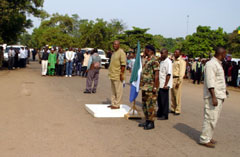
Local
dignitaries had assembled to welcome the President
and his entourage amid drumming, dancing and singing.
At the welcoming ceremony the Paramount Chief
of Malal-Marah Chiefdom, Bai N'lal N'soilla III,
thanked President Kabbah for the visit and said
that light had now entered their chiefdom since
that was the very first time in the history of
Sierra Leone that a Head of State had paid a visit
to the chiefdom. He further thanked President
Kabbah for ensuring that there was peace and tranquility
throughout the country and Malal-Marah in particular.
President
Kabbah, while making his address thanked Paramount
Chief Bai N'lal N'soilla III and the people of
his chiefdom for their hospitality and reiterated
that his mission as leader of the Nation is to
empower the people of Sierra Leone of every part
by creating the necessary conditions for development
and wealth-creation to take place.
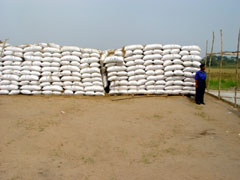
The
President's visit was principally to witness the
beginning of harvest by Mr. Sahid Koroma, who
together with others had undertaken to cultivate
some 3,000 acres of rice farm. The farm utilises
a number of tractors and harvesters and were on
display during the visit. The leader of the project,
Sahid Koroma, spoke about the farm and how he
entered into partnership with a few people to
cultivate the land and the support they had so
far received from the chiefdom people.
Mr.
Koroma called for government support by way of
providing assistance to irrigate the farmland
since they were operating on the banks of the
Rokel River and for the granting of waiver on
duty for machines they had imported.
In
his statement, President Kabbah praised Mr. Sahid
Koroma and his partners, together with the Paramount
Chief and people of the chiefdom for undertaking
such an impressive venture. He said that the work
they had engaged in was a boost to his food security
agenda and his proclamation that by 2007 no Sierra
Leonean must go to bed hungry. The President explained
that his vision of food security could be realised
if people worked hard and emulated the example
of Sahid Koroma and the people of Malal-Marah
and that 'food for all' could be attained well
before 2007. The President disclosed that an Investment
Code for the country was nearing completion and
that incentives for those operating in the business,
industrial and agricultural sectors of the economy
would be embodied in the code. President Kabbah
gave instructions to the Ministry of Agriculture,
Forestry and Food Security to address the issues
of providing technical assistance for an irrigation
scheme in the area and for collaborative steps
to be taken up with the Ministry of Works and
Technical Maintenance for an improvement of the
feeder road, starting from the junction on the
Makeni-Magburaka highway right up to the farmlands
of Malal-Marah.
President
Kabbah remarked about the general cleanliness
of all the villages and settlements on the way
to and in Malal and the marked contrast with Freetown,
where he said dirt and filth show up as if they
were deliberately generated. Cleanliness, the
President said, was something Sierra Leoneans
were known for and wondered why Freetown had problems
with sanitation and filth. He reached out to all
Sierra Leoneans to work for the good name and
image of the country and reminded all and sundry
that Sierra Leone was all that we can cling to
and call 'home'.
The
President addressed the issue of taxation and
explained that taxation forms the basis of government
revenue and told his audience that wealthy and
powerful countries such as the United States of
America, Great Britain and others derive their
wealth from taxation. He lamented, however, that
in Sierra Leone people tend to shy away from paying
taxes and instead look up to Government to provide
everything, from employment to shelter, food and
healthcare. Such a situation, he said, placed
government under immense pressure and called for
a rethinking and new positive attitude towards
government and the country's well-being.
President
Kabbah made a tour of the farm and returned to
Freetown the same day.
-End-
|


