Cabinet
Meets In Makeni.
CLICK HERE FOR
ACCOMPANYING PICTURE ALBUM
From
Wednesday June 11th to Saturday June 14th
2003, President Ahmad Tejan Kabbah and
his entire cabinet were housed in the
Northern capital city of Makeni. The President
and his team of cabinet ministers held
the second of such rotational cabinet
meetings outside the Freetown capital,
as part of a new government initiative
of taking the executive arm of government
to the rural folks.
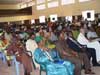 Addressing
an assembly of northern traditional rulers
and stakeholders at the Makeni Town Hall,
shortly after last Thursday's meeting,
President Kabbah said it was government's
duty to find out from the provincial people
themselves what their regional development
aspirations were. He maintained that in
making decisions that would directly affect
the lives of provincial people, government
must first sit together and consult with
them, so that they could together prioritise
projects and programs geared towards the
reconstruction and development of the
regions.
Addressing
an assembly of northern traditional rulers
and stakeholders at the Makeni Town Hall,
shortly after last Thursday's meeting,
President Kabbah said it was government's
duty to find out from the provincial people
themselves what their regional development
aspirations were. He maintained that in
making decisions that would directly affect
the lives of provincial people, government
must first sit together and consult with
them, so that they could together prioritise
projects and programs geared towards the
reconstruction and development of the
regions.
Re-iterating
an earlier statement he made at the first
regional cabinet meeting in Kenema last
month, the Head of State said there would
henceforth be no imposition of ideas
from Freetown. Government cannot sit
in Freetown and decide what the needs
of the rural people wereFreetown in not
Sierra Leone, he added.
He
went on to say that government had received
promises of support from friends and international
organisations, including the South-South
Cooperation project. Therefore, he said,
government had thought it fit to hang
heads with the people to find out what
type of services they require so that
development support received would benefit
the entire country. He also appealed to
northerners to be watchdogs of whatever
social services and facilities that would
be provided for them, as these belong
to them.
Vice
President Solomon Berewa, who also addressed
the gathering, said the focus of the regional
cabinet meeting was to prioritise projects
for the entire northern region. He explained
that immediately after the end of the
war, governments attention was directed
at ensuring that people do not die of
hunger and diseases, noting that government
had now moved away from providing relief
to undertaking such development projects
as construction of roads, schools and
hospitals.
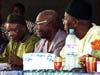 VP
Berewa indicated however that government
did not have all the financial resources
to undertake these projects, hence the
need for such consultations. Continuing,
the Vice President declared that it was
also governments policy not to govern
alone, but rather to include the thoughts
and ideas of the local peoples in decision-making
processes. This in not just politics,
he said, assuring his audience that government
would soon come back again to critically
review progress made.
VP
Berewa indicated however that government
did not have all the financial resources
to undertake these projects, hence the
need for such consultations. Continuing,
the Vice President declared that it was
also governments policy not to govern
alone, but rather to include the thoughts
and ideas of the local peoples in decision-making
processes. This in not just politics,
he said, assuring his audience that government
would soon come back again to critically
review progress made.
The
Vice President was however quick to point
out that regional cabinet meetings would
not focus on district matters per se,
but on the larger needs of the entire
northern region. He said District and
Chiefdom Recovery Committees would consider
projects at district and chiefdom levels.
In
turns, cabinet ministers took the podium
to outline the series of development projects
in store for the northern province, while
soliciting the suggestions and other relevant
inputs of stakeholders in that region.
Mr.
Emmanuel Grant, Minister of Energy and
Power affirmed that some of the most difficult
problems besetting the north was the lack
of pipe-borne water and electricity, but
observed that the only way the problem
of electricity could be addressed was
through the completion of the Bumbuna
hydro-electric power project. He was pleased
to note that efforts to provide pipe-borne
water to Makeni and other major northern
towns were well underway, adding that
studies were being conducted to identify
other sites that could provide water to
other parts of the region.
Education,
Science and Technology Minister Dr. Alpha
Wurie noted that as a result of the operating
free education system, over ten thousand
school children took public examinations
last year. He said a new rapid education
project designed to cater for the needs
of older pupils will soon be introduced
in the north, adding that government had
also introduced a new educational policy,
wherein every northern girl-child who
passes the National Primary School Exam
would have her school fees paid for by
government in Junior Secondary School.
He also spoke about a new legislation
on education, which would give community
stake-holders a substantial say over the
running of regional schools.
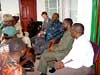 Justifying
the need for large-scale local food production,
the Minister of Agriculture, Dr. Sama
Mondeh disclosed that some fifty million
United States dollars is spent annually
for the importation of the staple rice.
He said the only way a nation could become
prosperous was for it to produce its own
food for domestic consumption as well
as for export to lucrative foreign markets.
He said government was committed towards
supporting indigenous Sierra Leoneans
to cultivate and produce more, noting
that meanwhile government had provided
tractors and other agricultural machinery
and had plans to provide additional inputs
to the region.
Justifying
the need for large-scale local food production,
the Minister of Agriculture, Dr. Sama
Mondeh disclosed that some fifty million
United States dollars is spent annually
for the importation of the staple rice.
He said the only way a nation could become
prosperous was for it to produce its own
food for domestic consumption as well
as for export to lucrative foreign markets.
He said government was committed towards
supporting indigenous Sierra Leoneans
to cultivate and produce more, noting
that meanwhile government had provided
tractors and other agricultural machinery
and had plans to provide additional inputs
to the region.
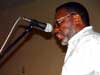 On
roads works and maintenance, Minister
Kaiser Boima revealed that work on the
Gberay junction - Pamlap road would start
in September of this year and that negotiations
for the Masiaka - Mile 91 - Taima roads
were well underway. He said funds were
available for the reconstruction of a
three hundred-kilometre-long road in the
north, but indicated that locals themselves
would determine and prioritise how and
where such a road should be constructed.
He further disclosed that funds were also
now available to connect Kabala in the
north and Koidu in the east.
On
roads works and maintenance, Minister
Kaiser Boima revealed that work on the
Gberay junction - Pamlap road would start
in September of this year and that negotiations
for the Masiaka - Mile 91 - Taima roads
were well underway. He said funds were
available for the reconstruction of a
three hundred-kilometre-long road in the
north, but indicated that locals themselves
would determine and prioritise how and
where such a road should be constructed.
He further disclosed that funds were also
now available to connect Kabala in the
north and Koidu in the east.
Mineral
Resources Minister Mohamed Swarray Deen
told the meeting that diamonds had been
discovered in the northern town of Kamakwie
and many other areas in the north. He
said government had revived the system
of giving out loans to miners in the form
of mining equipment. He also informed
them about the mining area development
fund, out of which government allocates
a certain percentage of the licences fees
to mining chiefdoms based on the number
of licenses issued out.
Health
minister Dr. Agnes Taylor Lewis said government
was in the process of rehabilitating all
district hospitals that were destroyed
during the civil crisis and that they
had also decided to set up provincial
medical stores to make drugs easily and
promptly accessible to regional medical
clinics. She reminded them that women
and children should not pay for drugs
provided by government hospitals.
Internal
Affairs minister George Banda Thomas said
government is desirous of establishing
fire-fighting stations in each of all
the twelve districts, but said this matter
would have to be prioritised in line with
resources at the disposal of government
now. He also spoke about moves to set
up more police stations and post.
Transport
and Communication Minister Dr. Prince
Harding explained progress achieved thus
far in the procurement of seventeen public
buses as a first phase in servicing the
public transportation needs of the regions.
He said his ministry also had plans to
decentralise the process of vehicle registration,
licensing and testing, adding that he
had been assured by the Celtel cellular
phone operators that the northern regional
headquarter town of Makeni and surrounding
areas would soon join other regions in
enjoying cell phone communication facilities.
Local
Government minister, Sidique Brima spoke
about governments plans to reform the
activities of district councils, disclosing
that DFID had already provided some support
for the rebuilding of district court barrays.
A very controversial issue put forward
for consideration by the people of the
north was that pertaining to allowing
northern women become paramount chiefs
as is the case in the southern and eastern
regions.
However,
President Kabbah, who acknowledged how
strongly some northerners were against
the idea of crowning women as paramount
chiefs, suggested a way of going around
the problem - appointing a male representative
through whom certain chiefdom authority
could be delegated so as to avoid any
breach of traditional laws. He maintained
that women could be as intelligent and
competent as their male counterparts in
traditional leadership positions.
The Minister of Youth and Sports, Dr Denis
Bright, also highlighted plans to bring
his ministry in closer touch with the
northern region by the setting up of a
provincial office for the effective coordination
of youth and sports activities. He said
the end of the war had brought with it
a considerable amount of youth related
problems that needed attention. He said
many provincial youths had no proper information
about what opportunities they stand to
benefit from and spoke of providing special
radio and television airtime to cater
for the views of the countrys growing
youth population.
Social
Welfare minister Shirley Gbujama, for
her part, spoke about the setting up of
psycho-social counselling centres for
traumatised children throughout the country,
while Marine Resources minister Okere
Adams revealed plans for the creation
of fish breeding ponds and stations in
land-locked northern regional communities.
He explained that the project was aimed
at increasing fish consumption in the
non-coastal regions as well as multiplying
the nations dwindling fish stock. Mr.
Adams stated that artisanal fishermen
would soon be provided loans in the form
of boats, fishing nets and other related
gears through the National Cooperative
Development Bank. He said these materials
would become the private properties of
the fishing cooperatives after a phased
repayment of the loans.
Paramount
Chief Kandeh Luseni of Sella Limba chiefdom
presented the position statement for the
northern region, which approves wholesale
the series of programmes and projects
earmarked by the government for the northern
region. Luseni thanked President Kabbah
for bringing his cabinet to the people
and lauded the governments introduction
of the national social security scheme.
He however called for the timely provision
of fertilisers, pesticides, seeds and
other farming inputs to farmers.
The
Paramount Chief also called for the road
to Bumbuna as well as the Port Loko -
Freetown road link to be reconstructed
soonest. Before the end of the public
meeting two chiefdoms Sanda Loko and Sella
Limba were awarded cheques to the value
of over six hundred thousand leones in
respect of proceeds from the mining area
development fund. Other regional mining
chiefdoms were encouraged to get miners
to take valid diamond mining licences
so that they too would benefit from the
fund.
 Speaking
to the BBC an interview following the
public meeting, President Kabbah said
the exercise has afforded the northern
people the chance to exchange views, have
their voices heard and obtain necessary
feedbacks. He said this would help government
in formulating the policies of tomorrow.
.
Speaking
to the BBC an interview following the
public meeting, President Kabbah said
the exercise has afforded the northern
people the chance to exchange views, have
their voices heard and obtain necessary
feedbacks. He said this would help government
in formulating the policies of tomorrow.
.
-
end of text -
CLICK HERE FOR
ACCOMPANYING PICTURE ALBUM
This
report was compiled by Yusuf Alghali


