|
His
Excellency the President, Alhaji Dr. Ahmad Tejan
Kabbah, Ends Official Visits Abroad
His
Excellency the President, Alhaji Dr. Ahmad Tejan
Kabbah returned to Freetown today Monday, 29 November,
2004 after visiting the Republics of Guinea, Algeria
and Libya on official government business.
On
the invitation of President Lansana Conte of Guinea,
PresidentKabbah paid a two-day working visit to
Guinea from Friday, 19 to 20 November. The two
Heads of State held discussions on a very wide
range of issues, from bilateral relations to matters
concerning the resuscitation of the Mano River
Union secretariat and the security situation in
the sub-region, particularly the crisis in Cote
D'Ivoire.
The
two Heads of State also undertook extensive travels
within Guinea to the main agricultural areas and
farms of the TANENEH and COBA districts in the
DUBREKA administrative zone. At the end of the
visit the two Heads of State issued a Press Statement
embodying the salient aspects of discussions,
understanding and agreements reached between them.
They reaffirmed their support to the reactivation
of the Mano River Union and expressed their desire
to use it as an instrument for the exchange of
experience on economic development, social and
political integration.
The
two Presidents expressed their appreciation for
the reopening of the Koindu International Market,
a centre that had served as a meeting point for
traders and businesspeople from Sierra Leone,
Guinea and Liberia since it was founded in 1932,
but which, unfortunately had to close down because
of the rebel war that began in that area in March
of 1991. It was observed by some coincidence that
President was born in 1932 and both leaders acknowledged
that the reopening of the market will take place
on the occasion of observing President Kabbah's
73rd birthday anniversary.
At
the bilateral level the two Heads of State reaffirmed
their commitment to pursue a peaceful and brotherly
solution to the border issue along the Makona/Moa
river in conformity with the Anglo-French Treaty
of 1912 and renewed by both the 1974 Accord between
Guinea and Sierra Leone and the Memorandum of
Understanding between the two countries, signed
on 2nd September, 2004, all of which stipulate
that the village of Yenga belongs to Sierra Leone
and that the Makona/Moa river in that vicinity
belongs to Guinea.
In
that connection the two Heads of State expressed
their desire for and encouraged the joint committee
of experts to carry out their assignment in a
brotherly and friendly spirit. They also encouraged
the members of Parliament of the respective Kissi
ethnic communities from Guinea, Liberia and Sierra
Leone who hail from that area to move forward
and hold their tripartite meeting in Sierra Leone
on 25 February 2005, as scheduled and work towards
consolidating their fraternal and cultural ties
as a way of ensuring lasting peace in the area.
President
Kabbah and his delegation left Conakry on Saturday
20th November for Algeria to attend the Summit
of African Heads of State of the African Peer
Review Forum and NEPAD, the New Partnership for
Africa's Development in Algiers under the auspices
of the African Union, from 22 to 24 November,
2004. In keeping with the commitment of African
leaders to enhance and deepen governance in Africa,
the 6th Summit of the NEPAD Heads of State and
Government Implementation Committee held in March
2003, adopted the Memorandum of Understanding
on the African Peer Review Mechanism and the Declaration
on Democracy, Political, Economic and Corporate
Governance. The African Peer Review Mechanism
(APRM) is a self assessment and monitoring tool
initiated by the members of the Inaugural Summit
of the African Union held in Durban, South Africa
in July 2002. The APRM aims to foster the adoption
of policies and practices that will lead to political
stability, high economic growth, sustainable development
and accelerated regional and continental economic
integration through sharing of experiences and
reinforcement of successful best practices.
So
far, only twenty-three countries in Africa have
acceded to the mechanism, of which the Government
of President Kabbah is a proud member. The other
countries are: Algeria, Burkina Faso, Cameroon,
Republic of Congo, Ethiopia, Gabon, Ghana, Kenya,
Mali, Mauritius, Mozambique, Nigeria, Rwanda,
Senegal, South Africa, Uganda, Egypt, Benin, Malawi,
Lesotho, Tanzania, Angola and Sierra Leone.
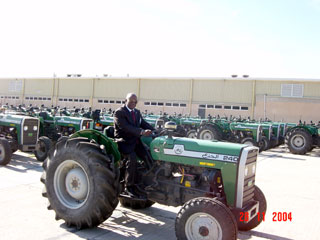
During
President Kabbah's stay in Algeria he visited
agro-based industries and a vehicle manufacturing
and assembly plant along the Algerian Mediterranean
coast and held fruitful bilateral discussions
with government and enterprise executives of the
country. On the question of environmental management,
it was proposed that an environmental protection
expert from Algeria should come to examine possible
ares of intervention in that field on a bilateral
basis.
The
third and last leg of President Kabbah's visit
was Libya where he had been invited to open the
7th Congress of the World Islamic Call Society
held in Tripoli on 26th November. The World Islamic
Call Society is a non governmental, inter-religious
oriented organization that encourages dialogue
among the world's great religions, particularly
between Islam and Christianity. The 7th Islamic
Call Society conference was attended by heads
and representatives of many Islamic, Christian
Churches and Orthodox Churches from all over the
world, including the Vatican, the Greek Orthodox
Church, the Patriarch of the Egyptian Coptic Church,
etc.
In
his address to the conference, President Kabbah
spoke about the need for harmony and tolerance
among the leaders and followers of the different
religious faiths, especially those that worship
and follow the commandments of the one monolithic
God or Allah. He preached about the oneness of
our faith and reminded the congregation that it
is only through tolerance that the world can realize
true peace and that it is only by peaceful coexistence
can the peoples of the world create the conditions
necessary for them to live and practise their
different forms of worship.
He
cited Sierra Leone as a country where religious
tolerance has been practiced over the years, to
the extent that both Christians and Muslims join
in celebrating each others' important observances
such as Christmas and Easter by Muslims and Eid-Ul-Fitr
and other Eids and Islamic remembrances by Christians.
While
in the Libyan Capital President Kabbah held discussions
with Libyan leader, Moammar Qadaffi on a number
of bilateral issues. The two leaders spoke about
new Libyan investment in Sierra Leone and the
prospect of a second ferry that is expected this
month in order to ease movement between Freetown
and Lungi and to other places like Bonthe. The
Libyans who are already in discussion with petroleum
officials here in Freetown indicated their preparedness
to establish a petroleum depot in Freetown that
could serve other countries in the sub-region,
as well as meeting the local requirements for
petroleum products.
After
visiting a Libyan tractor manufacturing plant
in Tripoli President Kabbah expressed interest
in importing some twenty tractors with associated
implements such as ploughs in order to promote
agricultural development in Sierra Leone. Other
matters of bilateral and multilateral interests
were discussed, among them the need for President
Kabbah to play a mediating role in settling certain
matters that are of concern to the African Union.
-END-
|