President
Kabbah and VP Berewa End Kono and Kailahun Provincial
Tour
By Yusuf Alghali
9th
February 2004 - The President, Alhaji Dr.
Ahmad Tejan Kabbah, and Vice President Solomon
Berewa returned to Freetown Monday 9 February,
concluding a four-day extensive visit to Kono
and Kailahun Districts in Sierra Leone's eastern
region. Prominent among the important towns
covered by the visit were Yengema and Koidu
in the Kono District, Koindu, Kailahun Town,
Pendembu (the President's birthplace), Siama,
Manowa, Bunumbu, Segbwema, Baiwallah, Daru,
Jojoima, Bomaru, which experienced the first
gunshots that heralded the start of the civil
conflict on 23 March 1991, and the President's
maternal birthplace of Mobai.
On arrival in Kono Thursday morning 4 February,
the President first commissioned the newly rehabilitated
Motema Police Station and Magistrate Court in
Koidu Town, two among the countless public buildings
not spared during the widespread carnage and
pillaging that accompanied the country's just-ended
civil conflict. Rounding up his visit to Kono,
the President also inspected the Branch Enegry
(Koidu Holdings) Kimberlite mining site.
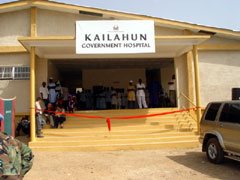
In
the events that followed their arrival in Kailahun
District, the President and Vice- President
went on to officially commission a series of
newly rehabilitated public structures, including
the once devastated Government Hospital in Kailahun
Town which was undertaken by the International
Medical Corps (IMC) with funding by USAID, several
schools as well as newly constructed police
stations to maintain law and order in the border
district and erstwhile rebel stronghold. The
formal opening of Police Stations in Pendembu,
Daru, Kailahun Town and Segbwema were indications
that government authority has now been fully
restored throughout the length and breadth of
the country and for the promotion of law and
order in these areas, Vice President Berewa
said in an address to the people of Kailahun.
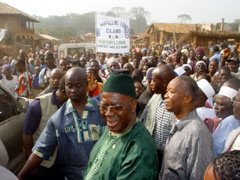
At
each of the various stopovers, both President
Kabbah and Vice President Berewa addressed the
people about security and developmental issues
and apprised the hundreds and in some cases
thousands of locals about government's recently
launched SABABU Education Project, formulated
to address basic education and undertake the
rehabilitation Non-Formal Education and Vocational
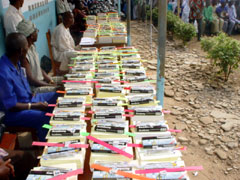
Skills training in the country. In this regard,
Vice President Berewa re-emphasised the importance
of the education of the girl-child and proceeded
to distribute school fees, free textbooks, uniforms
and other essential stationery to which every
eastern and northern provincial girl child who
passes the National Primary School Examination
is entitled. Also as part of government's national
recovery programme fifty-two primary schools
will be built in the entire Kailahun district
and a Junior Secondary School in every chiefdom
throughout the country's one hundred and forty-nine
chiefdoms.
While
encouraging women's participation in the upcoming
local government elections scheduled for May
2004, the President indicated that the pending
District Council elections were in keeping with
government's declared policy of decentralising
governance and empowering people in the regions
to have a greater say in the running of their
local affairs. He therefore emphasized the need
for vigilance, collective security and hard
work, elements he referred to as prerequisites
for national development and prosperity.
However,
he also took the opportunity while in Bomaru,
to issue a stern warning to would-be troublemakers,
assuring the public that government and its
security apparatus stood ready to nip in the
bud any trouble and to defend the country and
its citizens at any time. Earlier, President
Kabbah had listened to testimonies of victims
- Mrs. Baindu John and Mr Momoh Konneh, both
of whom witnessed the March 23rd 1991 invasion
of Sierra Leone and the attendant slaughter
and other atrocities that signalled the beginning
of the rebel war that was to last more than
a decade.
At
Bunumbu Town, the President and entourage inspected
the ruins of the once famous Bunumbu Teachers'
College, another tertiary institution that felt
the brunt of the rebel war. In his address at
a public meeting in Bunumbu the President renewed
his government's commitment to restoring the
once vibrant college to serve the educational
needs of that part of the country.
Earlier
at Pendembu, President Kabbah officially opened
a USAID/International Rescue Committee (IRC)-sponsored
Vocational Training Centre in the Upper Bambara
Chiefdom. According to USAID Director, Julie
Koenen, USAID had taken up the challenge to
putting into good use the strength and talents
of the youthful population by supporting the
erection of the centre, which the IRC country
Director, Allan Mukuru, derscribed as the IRC's
assistance to rebuild community infrastructure
critical to Sierra Leone's post-war recovery.
In
another engagement, the Head of State also delivered
the keynote address at the launching of the
UNDP/UNAMSIL-sponsored Eastern Clinic Rural
Development Rehabilitation Project in Mobai
(ECRD), Mandu Chiefdom, initiated by one of
Sierra Leone's most renowned medical practitioners
and master-farmers, Dr. B.M. Kobba. The ECRD
is an ambitious oil palm rehabilitation and
expansion project with a potential of not only
increasing domestic oil palm production significantly
but of also creating employment opportunities
for scores of the local youth population in
oil palm planting, processing, milling and soap
making skills. Br. Kobba in his statement lent
his support to the President's food security
vision and said that with some motivation, Mobai
was capable of producing a large percentage
of rice needed by the whole country.
President
Kabbah re-stated his declared vision of food
security and called on local farmers to join
the bandwagon. However, President Kabbah acknowledged
that there could be no food security without
good roads, an issue which he said was currently
receiving the close attention of government.
He disclosed that there were some funds available
for road construction from Kenema to Koindu,
pointing out that some 216 kilometres of feeder
roads will be constructed country-wide within
the next two years. He thus urged traditional
rulers and farmers to hold consultations with
the Sierra Leone Roads Authority in order to
establish which agriculture-related feeder roads
should receive the most urgent attention when
the project eventually kicks off.
Concluding
his visit to Kailahun Monday morning 9 February,
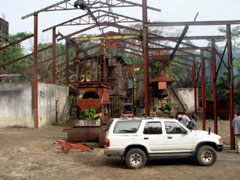
President Kabbah toured the dilapidated ruins
of the once economically viable Daru Oil Palm
Company consisting of a mill and 3,000 acres
of oil palm plantation, which during its heydays
used to produce up to 50 tonnes of palm oil
per month. In his brief remarks, Agriculture
Minister Dr. Sama Monde indicated that Malaysian
oil palm experts have expressed interest in
reviving the facility under a proposed joint
venture oil palm plantation and milling project
by the middle of this year. Already, 30,000
oil palm seedlings have been procured from COTE
D'IVOIRE and a further 50, 000 seedlings were
being awaited for onward distribution to farmers.
The
four-day visit also featured the swearing-in
of Justices of the Peace to help with adjucating
magistrate court cases in the Kailahun Judicial
District, statements from traditional rulers
most of whom acknowledged the many impressive
rehabilitation work carried out by government
through the National Commission for Social Action
(NaCSA), the Sierra Leone Roads Authority (SLRA)
and non-governmental organisations. Traditional
rulers also expressed varying local chiefdom
needs such as the urgent rehabilitation of health
centres, schools, transportation, telecommunication
facilities, better deal for cocoa farmers, bridges,
feeder and trunk road rehabilitation, rehabilitation
of tree crop plantations, water supply, shelter
and youth development programmes, chiefs' participation
in teachers' verification exercises, etc.
Vice
President Berewa, who pointed to government's
meagre resources, assured the people of government's
continued commitment to providing their social
and welfare needs but underscored the importance
of prioritising needs that could be addressed
between the short to the medium term.
A
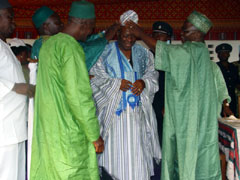
high point of the tour was the ceremonial crowning
of President Ahmad Tejan Kabbah as Honorary
Pararamount Chief Gbornie of Jawei Chiefdom
in Daru, in recognition of his untiring efforts
to restore peace and development to Sierra Leone.
-End-


