President
Kabbah Holds Talks With Bangladeshi Prime Minister.
By Yusuf Alghali
Tuesday
21st October 2003: Rounding up his week-long
visit to Malaysia Tuesday, President Ahmad Tejan
Kabbah arrived at the Zia International Airport
in Dhaka, capital city of the People's Republic
of Bangladesh, at the start of his three-day
official visit to the country.
The
President, who was received on arrival by his
Bangladeshi counterpart, President Professor Dr.
Iajuddin Ahmed and Prime Minister Begum Khaleda
Zia, later held bilateral discussions with the
Prime Minister together with senior members of
her cabinet.In
the ensuing discussions, President Kabbah indicated
his readiness to establish as well as develop
strong investment and technological links with
Bangladesh, a country with which he said Sierra
Leone had a lot in common.
Answering
to questions from the press outside Prime Minister
Zia’s office following their closed-door
talks, President Kabbah described the meeting
as useful and acknowledged that export and trade
issues had indeed formed part of the discussions.
The
two leaders agreed to increase co-operation
in a number of areas, including agriculture,
trade, education, textile, garments and pharmaceuticals.
Bangladesh is reputed to be among the leading
producers of generic drugs and indications are
that Freetown and Dhaka may soon finalise mutual
co-operation agreement in the pharmaceutical
domain.
During
his earlier visit to the Dhaka Export Processing
Zone (DEPZ) and the Garment Factory at DEPZ
in Savar, Dhaka, President Kabbah expressed
profound interest in having business alliances
or joint venture business investments established
between Bangladeshi garment manufacturers and
their Sierra Leonean counterparts, after due
consultations with the Ministry of Trade as
well as the Chamber of Commerce and Industry
in Freetown.
Later,
the Head of State and entourage, including Secretary
to the President Sheka Mansaray, Foreign Minister
Momodu Koroma, Agriculture Minister Sama Mondeh
and Ambassador Haja Al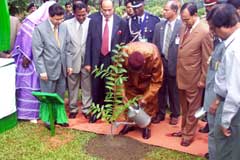 arie
Cole, viewed the Bangladesh Textile Exposition
(BATEXPO) at Hotel Sonargaon, organized by the
Bangladesh Garments Manufacturers and Exporters
Association (BGMEA). He disclosed that his country’s
door was wide open to genuine investors and
businesspeople, pointing out that as developing
countries, both the Republics of Bangladesh
and Sierra Leone must collaborate for their
mutual advantages in the spirit of South-South
Co-operation.
arie
Cole, viewed the Bangladesh Textile Exposition
(BATEXPO) at Hotel Sonargaon, organized by the
Bangladesh Garments Manufacturers and Exporters
Association (BGMEA). He disclosed that his country’s
door was wide open to genuine investors and
businesspeople, pointing out that as developing
countries, both the Republics of Bangladesh
and Sierra Leone must collaborate for their
mutual advantages in the spirit of South-South
Co-operation.
Shortly
before attending a state banquet and cultural
show hosted in his honour Wednesday evening,
President Kabbah and delegation had detailed
discussions at his Sheraton hotel suite with
a number of Bangladesh’s government representatives
on a comprehensive range of issues. Prominent
among those with whom discussions were held
were the Foreign Minister, Mr. Morshed Khan,
the Chief of Army Staff, Lt. General Hassan
Morshud Chowdhury, the Minister of Local Government,
Rural Development and Cooperatives, Mr. Abdul
Mannan Bhuiyan and the Minister of Textiles,
Mr. Abdul Matin Chowdhury, who agreed with President
Kabbah’s earlier suggestion about the need
to have an exchange of exploratory visits by
each of the two country’s chambers of commerce
institutions.
Led
by the Minister for Liberation War Affairs,
Professor M. Rezaul Karim, President Kabbah
solemnly laid a wreath at the National Martyrs
Memorial in Savar and proceeded to plant a sapling
at the memorial site as a bugler plays the Last
Post.
MALAYSIA:
During
the final leg of his of visit and consultations
with key Malaysian business enterprises and
investment institutions, President Kabbah was
taken on an inspection tour of the highly successful
Malaysian Federal Land Development Authority
(FELDA) in Jempol, Negeri Sembilan, over 150
kilometres outside Kuala Lumpur.
FELDA
is a Malaysian government-supported project,
designed to encourage farming families to maximize
the cultivation of oil palm, by relocating them
into well-furnished settlements near the plantations.
Over the years, Malaysians have developed their
palm oil industry to such an extent that every
single part of the oil palm plant has been put
into some profitable industrial use. Apart from
the crude palm oil itself, which can be processed
into a thoroughly refined brand of cholesterol-free
cooking oil, margarine, butter, sausage, ice
cream powder, herbal soaps, oil-based cosmetics,
vitamins and engine fuel, the fronds, trunks,
kernel shells and fibre (biomass) that remain
after the oil had been pressed, could also be
processed to produce electric energy, animal
feed, paper, hard-board and a range of other
household utensils. Workers at the palm oil
mill say energy from oil palm wastes provide
some five percent of the total electricity consumed
at the mill.
Obviously
impressed with what he saw, President Kabbah
reiterated his keenness about getting the Malaysians
to help boost Sierra Leone’s oil palm production
and processing through the transfer of appropriate
technology and skills, joint-venture investment
and expertise. He said he would leave no stone
unturned in efforts to import the skills and
know-how behind the FELDA oil palm success story.
BANGLADESH:
President
Kabbah, before departing Dhaka Thursday 23rd
October for Dubai, addressed members of the
Federation of Bangladesh Chamber of Commerce
and Industry (FBCCI) at a special luncheon meeting
held at the Dhaka Sheraton. He spoke about the
vast business investment potentials that currently
exist in Sierra Leone, urging members of the
FBCCI to expedite the dispatching of a delegation
to Sierra Leone soonest.
In
his statement earlier, President of the FBCCI,
Mr. Abdul Awal Mintoo, said he was pleased to
note that during bilateral discussions, certain
sectors were identified for immediate cooperation
to enhance trade and economic ties between the
two developing nations in the sphere of medicines,
agriculture, leather products, electronics,
toiletries, household goods and ready-made garments.
He
disclosed that Bangladesh had made “tremendous
progress over the past several years in cereal
crops and vegetable production”. He added:
“It is our agriculture community that effectively
transformed this country from a basket case
of economy in distress to a situation of food
autarky.” He said Bangladesh also now had
a state of the art diamond-cutting factory.
“Keeping these elements in mind, we believe
there are economic and trade benefits to be
gained by bringing together the supply of diamonds
from Sierra Leone and the cutting, polishing
of diamonds and making designed jewelry in Bangladesh
for export, as well as for the internal market,”
Mr. Mintoo told President Kabbah, who wraps
up his three-day official visit to Bangladesh
today.
Following his brief visit to Dubai the President
and entourage will return home Monday 27th October.


