|
President
Kabbah back home from Abuja Summit
By
Yusuf Alghali
The
government of Sierra Leone has received high commendation
for having
performed creditably and making prompt contributions
towards the success of the second West African
Monetary Zone Programme, notwithstanding the country's
recovery agenda and economic difficulties.
.
Addressing the Summit of Heads of State of the
West African Monetary Zone (WAMZ) held in Abuja,
Nigeria on Friday 29 August, 2003, ECOWAS Executive
Secretary, Mohamed Ibn Chambas, observed that
in spite of its conflict situation and the on-going
reconstruction and rehabilitation efforts, Sierra
Leone had done extremely well in meeting its obligations
to the convergence process.
He
was, however, concerned that Liberia, also because
of its own conflict situation, had not been part
of the regional monetary integration process,
but he expressed hope that with the gradually
stabilising situation, Liberia would soon join
the other West African nations in the process.
Mr.
Chambas recalled that during last year's summit
in Guinea, Conakry, a decision was reached to
shift the date for a regional common currency
to 2005, as none of the countries had met all
four of the required convergence criteria.
Mr
Chambas was nonetheless pleased to report the
notable improvements made by some member countries
in meeting most, if not all, of the criteria,
according to the latest report, but called for
more effort to be made in improving revenue mobilisation,
revenue controls as well as pursuing more prudent
fiscal polices. The Ecowas scribe expressed the
hope that this time round countries would do their
utmost to meet the scheduled date of July 2005.
President
Kabbah, in his remarks, noted that the once volatile
West African sub-region is gradually achieving
the much-desired political stability which is
essential for economic growth and development.
For this, he expressed gratitude to the government
and people of Nigeria for the sacrifice it had
made and continues to make in human, financial
and material terms in order to restore security
and political stability in the region.
He
also registered his appreciation of the efforts
of President John Kuffour of Ghana, who is also
Chairman of ECOWAS; retired General Abdulsalam
Abubakarr, ECOWAS chief mediator on Liberia and
the Executive Secretary of Ecowas, Dr. Ibn Chambas,
for ensuring a durable solution to the Liberian
conflict. Given the hard les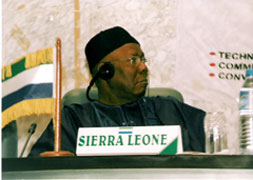 sons
learnt during the decade-long conflict and the
general climate of instability, President Kabbah
said Sierra Leone wholeheartedly welcomed the
recent positive developments in Liberia, which
signal renewed hope for security in the sub-region. sons
learnt during the decade-long conflict and the
general climate of instability, President Kabbah
said Sierra Leone wholeheartedly welcomed the
recent positive developments in Liberia, which
signal renewed hope for security in the sub-region.
He
stated that internal conflicts within the member
states of the sub-region disrupt economic progress,
increase poverty and create a lot of suspicion
between governments, not to mention the potential
threat to foreign investment.. In light of the
aspirations for regional monetary union, he said,
only the promotion of good governance will bring
about added impetus to the realization of the
dream of free enterprise and trade, free movement
of persons, economic co-operation and growth.
"My
Government is working strenuously to lay solid
foundations to match its commitment to the introduction
of a common currency in the West African monetary
zone by July 2005" the President affirmed,
but stated that for a country just emerging from
"a devastating civil conflict" it would
not be an easy task. However, he indicated that
his government had provided the political will
by ensuring that the legal and institutional frameworks
and arrangements were complete.
The
Sierra Leone parliament had ratified the statutes
for the creation of the West African Monetary
Zone and the establishment of the West African
Central Bank. In addition, he reported that his
government had endeavoured to pay its contributions
regularly to the Operational Funds of the West
African Monetary Institute (WAMI) and the Stabilization
and Co-operation Fund and had almost finalized
arrangements to settle its obligation to the capital
subscription of the West African Central Bank.
President
Kabbah was also pleased to report that Sierra
Leone's private sector was gradually responding
to the promotion of economic growth, resulting
in improved performance on the macro-economic
front, with inflation still within the single
digit. However, he disclosed that the budget deficit
ratio had not beenachieved owing to the difficult
socio-economic circumstances bedevilling the post-conflict
country.
While
underlining the importance of fiscal discipline
in satisfying the convergence criteria, Dr. Kabbah
said government had adopted the Medium Term Expenditure
Framework (MTEF) to "rationalize expenditure
on the basis of a three-year rolling programme,
in line with the available resource envelop".
Government, he went on, had also introduced a
participatory approach in the budgetary process
from preparation to execution and implementation.
The
President further underscored the importance of
sensitisation, especially for those in rural areas
who still cannot avoid the temptation of referring
to the now obsolete pounds, shillings and pence
in counting their monies. In this regard, he referred
to his launching of the national sensitization
programme in February of this year, with a pledge
to provide substantial resources to the national
sensitization committee to enable it reach out
to all stakeholders throughout the country.
President
Kabbah concluded by emphasising the fact that
political, economic and social stability in the
sub-region could only be achieved, if all concerned
were prepared to make the necessary sacrifices
and commitments.
The
new Chairman of the West African Monetary Zone
and Summit host, President Olusegun Obasanjo,
was delighted that the meeting provided an opportunity
for Heads of State to re-affirm their commitments
to move the single currency programme forward.
President
Obasanjo said the landmark decision in Conakry
last year made it possible for countries to adjust
their macro-economic policies and programmes which
had resulted in significant progress. He joinedSecretary
General Chambas in emphasising that "more
needs to be done", while also calling for
the preparation of country programmes spelling
out modalities for meeting the monetary integration
criteria on time.
President
Obasanjo also re-echoed President Kabbah in reiterating
the importance of peace and security, harmony
and solidarity for the achievement of a common
currency for West Africa
A
communiqué issued at the end of the summit
also called for member states to strengthen their
management systems and ensure effective implementation
of the relevant policy measures outlined in their
2003 budgets. Member countries were also enjoined
to sustain their efforts in the implementation
of the qualitative aspects of the convergence
programme.
According
to the communiqué, "the West African
Monetary Zone Exchange Rate Mechanism" (WAMZ/ERM)
should be renewed from January 2004 in support
of the WAMZ convergence process. The mechanism
would continue to provide useful information on
the effectiveness of fiscal and monetary policies
under the WAMZ programme.
Experts from the national Central Banks were urged
to meet to prepare the modalities of the mechanism
to enable WAMI circulate to member countries a
revised operational manual by the end of October
2003. Member Central Banks should continue to
provide regular and timely data on exchange rate
developments in the Zone to WAMI.
"In
order to guarantee the independence of the West
African Central Bank (WACB) and strengthen its
monetary policy management, the Summit endorsed
the proposed changes by the Convergence Council
to the Statute of the Bank adopted in 2000. The
Summit of WAMZ will officially sign the new Statute
in December 2003.
"The
Summit took note of technical and financial support
being given by several international organizations
to the West African Monetary Institute for the
implementation of the WAMZ programme. While welcoming
such healthy partnerships, it advised member countries
of the Zone to take advantage of the opportunities
given to strengthen their preparations for the
monetary union.
"The Summit endorsed the proposal to undertake
a study on payment systems development in the
WAMZ, to among others, improve the transmission
mechanism of the monetary policy of the WACB.
It urged the technical officials to expedite the
process of conducting the study to enable implementation
of appropriate proposals commence as early as
possible."
-End-
|


