Irish
Development Cooperation Team On Exploration
Visit
By Yusuf Alghali
7th
October 2003- A visiting three-man mission
led by the First Secretary of the Irela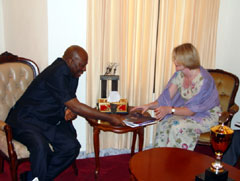 nd
Development Cooperation Directorate, Ms. Aine
Hearns, has told President Ahmad Tejan Kabbah
that the organisation would be looking at how
to enhance a deeper engagement with Sierra Leone
within the next eighteen to twenty-four months.
nd
Development Cooperation Directorate, Ms. Aine
Hearns, has told President Ahmad Tejan Kabbah
that the organisation would be looking at how
to enhance a deeper engagement with Sierra Leone
within the next eighteen to twenty-four months.
Speaking
during a meeting with the President at his
Hill Station Lodge today, Ms. Hearns explained
that theirs was an exploratory mission looking
at the achievements made in Sierra Leone since
the war ended. She said Ireland has planned
to spend some USD 450 million on overseas
development cooperation and that Sierra Leone,
a country just emerging from conflict, is
among a list of six eligible sub-Saharan countries
to be targeted.
She
disclosed that the mission had had meetings
with a number of government ministries, donors,
UN agencies, as well as local and international
non-governmental organisations, from which they
had obtained a broad range of views regarding
the prevailing situation in Sierra Leone.
Hearns,
who looked forward to expanding their programmes
in future, said the team would like to learn
about how government had been managing the myriad
of problems and challenges faced by it so that
when they return to Ireland, they would be able
to develop suitable strategies for cooperation
within the next two years.
The
ensuing discussion focused mainly on how government
was responding to the problem of corruption,
the implementation of government's decentralisation
policy, including the management of resources
allocated to that process, as well as local
capacity to meet the challenges.
President
Kabbah recognised the longstanding relationship
between the Republic of Ireland and Sierra Leone,
pointing to what he called the Irish influence
that had flowed into Sierra Leone particularly
in the area of education. However, he regretted
that there had been no "official Irish
representation" in the country for quite
some time except the presence of an Irish Consul
General in the person of Mr. Wadi Aboud.
The
Head of State made reference to those years
of civil conflict in Sierra
Leone, pointing out that even before that period,
both the national economy and other social infrastructure
had been destroyed. He said after the successful
achievement of peace, his government tried to
convince development partners to help with developing
the country's roads infrastructure as well as
the damaged energy, educational and health sectors.
Emphasising
the need for more ambulances, health centres
and clinics across the country, the President
said there was also a need for the setting up
of referral hospitals to service each of the
three provincial regions, while noting that
an upgraded Connaught Hospital would serve the
Freetown capital.
The
President indicated that many of its development
partners, including the European Union, the
African Development Bank, the Arab Bank for
Economic Development in Africa (BADEA) and the
Bretton Woods Institutions, were interested
in the energy, health and educational sectors,
but noted that some projects had not reached
implementation stage as yet. The
President also spoke of the Bumbuna Hydro-electric
project still awaiting completion and the proposed
Bikongo mini hydro dam project in the east of
the country, for which the Chinese government
had indicated its support. He also said the
African Development Bank (ADB) had expressed
its readiness to pay for the feasibility studies
and design of the proposed road link between
Freetown and the Lungi area. He said funding
would be required after the studies and design
were completed.
On
the issue of corruption, President Kabbah stressed
that his government was working hard to address
the malaise, but noted that there were teething
problems characteristic of such oversight institutions.
The President, who maintained that there were
no sacred cows in his government, acknowledged
that the lack of adequate capacity in the area
of prosecution and investigation was responsible
for the "gridlock" situation. However,
he made reference to the two commonwealth judges
to be provided under a Commonwealth Technical
Assistance, one of whom was already in Freetown,
poised to start clearing the backlog of corruption-related
offences shortly. The President proceeded to
cite a recent corruption-rating by Transparency
International, which indicated that Sierra Leone
was not listed among countries well known for
corruption.
Continuing,
he said his administration was conscious of
the problems posed by disaffected youths in
any post-conflict situation. He said the country
was badly in
need of industries for the training of youths
as well as job opportunities to make them a
productive force. He also mentioned his vision
for a hunger-free Sierra Leone by the end of
his current term, pointing out that the country's
youths could also be trained to work on the
farms, from which surplus produce would be sold
to European and American markets.
On
the decentralisation process, the President
said government was desirous of strengthening
the capacity of district councils so as to enable
them operate effectively as local governant
authorities.
Asked
about his views regarding a possible UNAMSIL
drawdown, President Kabbah said his understanding
of the Security Council resolution was that
the peacekeepers' presence in the country would
be reviewed after every six months until such
a time when the local police and military would
be adequately trained and equipped to fill the
vacuum that might be occasioned by a draw-down.
President Kabbah, however, expressed confidence
in the army and police and said that training
and other human development issues undertaken
by the army and the police were encouraging.
-End-


