Independent
Media Commission Presents Annual Report
By Marian Samu
The
Independent Media Commission (IMC), which came
into operation in 2000 by an Act of Parliament,
has presented its maiden annual report since
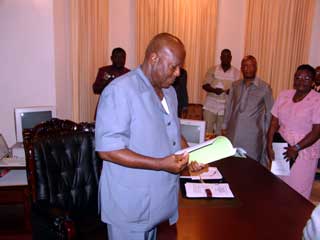
its inception to President Alhaji Dr Ahmad Tejan
Kabbah at his Hill Station office in Freetown.
At
the presentation ceremony, the Chairperson of
the IMC, Mrs. Bernadette Cole who took up appointment
in 2005, told President Kabbah that the year
2005 witnessed substantial progress in the IMC.
As of its key mandates, is to develop rules
and regulations governing the operations of
the media in Sierra Leone and a Media Code of
Practice, the IMC Board took up this mandate
with zest, and with the active collaboration
of the Sierra Leone Association of Journalists
and other stakeholders the exercise was pursued
simultaneously with the revision of the IMC
Act 2000 to synchronize the information in the
Media Code of Practice with that in the Act
to minimize conflict in the future. These documents,
she said, which are currently being processed
by the Law Officers' Department for the attention
of, and ratification by Parliament would provide
the much needed guidelines to journalists for
self regulation and for strengthening the authority
of the IMC to carry out its functions more effectively
Among
the successes of the IMC Mrs. Cole informed
the President that with funds from DFID, the
Commission has developed a Resource Centre to
ensure that media institutions achieve the highest
level of efficiency in the provision of media
services and an annual IMC/CELTEL media awards
scheme as an incentive for proficiency and excellence
in reporting.
In
keeping with its mandate to promote media pluralism
and freedom of expression throughout the country,
the Commission registered 7 new newspapers,
12 new radio stations, 5 new television stations
and 3 Direct to Home/DSTV agencies, bringing
the total number of newspapers operating in
the country to 39, radio stations to 31, international
radio relay station to 4, DTH/DSTV agencies
to 4 and television stations to 6, although
only three of them are operational
Mrs.
Cole also explained that the Commission successfully
dealt with twenty-six out of twenty-seven complaints
received from the public against one radio station
and various newspapers during the year under
review, while one is still pending. She congratulated
all those newspapers that came out regularly
and were never brought before the Commission
with complaints throughout the year.
Talking
about SLAJ's call for a repeal of the defamation
and seditious libel laws, the IMC Chairman said
following the receipt of a letter from the President's
Office stating his thoughts on the issue, the
IMC formed a Committee comprising SLAJ and the
IMC to chat the way forward. As the laws do
not only affect journalists, but also the entire
citizens, series of workshops and consultations
were held across the country. It however came
out that those who do not favour a change in
the laws were in the majority, with the argument
that if with the "obnoxious laws"
the journalists publish libelous articles, false
news, inaccuracies and half truths with impunity
almost on a daily basis, what legal protection
would the citizens have if the laws were repealed.
As
there were arguments for and against the laws,
Mrs. Cole advised that civil society organizations,
in particular SLAJ should continue to sensitise
the populace about these laws through workshops,
seminars and radio discussion programmes, while
journalists must themselves make conscious effort
to turn around the bad image they have in the
society so that more people will appreciate
the need for a review of these laws.
On
future plans, Mrs. Cole said the Commission
intends to provide a more conducive and efficient
working environment by ensuring that adequate
office equipment is in place. She also stated
that with the spread of media institutions,
and in particular radio stations throughout
the country, there is need to set up of satellite
offices in the regions to decentralize its work
. The Commission also needs a sturdy vehicle
to be able to work more closely with the media
institutions around the country.
As
the body mandated to advise the government on
media policy, Mrs. Cole said that the Commission
intends to work with the group that has been
calling for the enactment of the Access to Information
Act, so that collectively with other stakeholders,
such an Act could be developed for the attention
of Parliament.
She
however called on government to consider an
increase in its subvention to enable the Commission
take on the many challenges that lie ahead as
the Commission is constrained by lack of funds
and adequate logistics including vehicle and
thanked Government for giving the Commission
a free hand to pursue its mandate without any
interference.
The
President, Alhaji Dr Ahmad Tejan Kabbah in his
response said he was highly impressed with the
well thought out report, adding that this was
the first report to be presented to the government
since the setting up of the Commission.
He congratulated the chairman and members and
for the professionalism exhibited in carrying
out their responsibility. He
gave
the assurance that government would find time
to study it and respond to some of the issues
raised.
He
was pleased to note the chairman's statement
confirming the non-interference of government
in the Commission's work. He said he has very
high regards for the journalism profession,
adding that in normal situation, SLAJ should
be a very powerful institution to see that democracy
is maintained. He observed that in countries
like the UK and the United States journalists
are very highly regarded because they do their
job in a professional way, and get the truth
to the people. But spreading slanderous and
libelous news presents a bad image of the country.
He therefore advised all to try to protect the
image of this country as it is all ours.
The
conflict, he said has taken us 25 years backwards
and we should all try as much as possible to
put the conflict behind us and work towards
national cohesion.
-End-