|
HIS
EXCELLENCY, THE PRESIDENT, ALHAJI DR. AHMAD TEJAN
KABBAH, RETURNS TO SIERRA LEONE.
President
Kabbah returned to Freetown on 28th July 2003
after his official travels to Senegal, Mozambique
and The United Kingdom.
In
Dakar, Senegal, President Kabbah was guest to
President George Bush of The United States of
America and host President, Abdulaye Wade. President
Ahmad Tejan Kabbah was in Dakar at the invitation
of America's President George 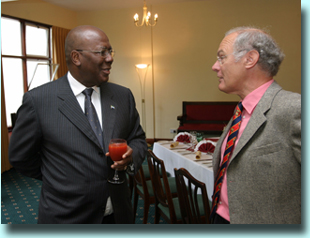 Bush
where he started his five-nation African tour.
In Dakar, Senegal, President Bush invited seven
West African Heads of State from Niger, Benin,
Ghana, Cape Verde, Mali, The Gambia, Sierra Leone
and of course Senegal, to have some meeting of
minds. These eight countries, President George
Bush described as countries whose leaders "have
firmly embarked on the path to democratisation." Bush
where he started his five-nation African tour.
In Dakar, Senegal, President Bush invited seven
West African Heads of State from Niger, Benin,
Ghana, Cape Verde, Mali, The Gambia, Sierra Leone
and of course Senegal, to have some meeting of
minds. These eight countries, President George
Bush described as countries whose leaders "have
firmly embarked on the path to democratisation."
After
the Dakar meeting President Kabbah proceeded to
Maputo, Mozambique where he attended the Assembly
of Heads of State and Government of the African
Union from 10th-12th July, 2003.
Following
the end of his meeting in Mozambique, the President
traveled to the United Kingdom to deliver a paper
at the Royal Commonwealth Society in London on
the theme "PROSPECTS FOR LASTING PEACE AND
DEVELOPMENT IN SIERRA LEONE."
During
his visit to the United Kingdom President Ahmad
Tejan Kabbah held discussions on bilateral cooperation
with the British Foreign Secretary, Jack Straw,
at 10 Downing Street in London, standing in for
Prime Minister Tony Blair who was on overseas
official visit.
Some
of the immediate outcomes of President Kabbah's
bilateral discussions with the United Kingdom
Government were the UK's renewal of commitment
to support Sierra Leone's security and Development.
Following a meeting with Foreign Secretary Jack
Straw on the 22 July, the UK Foreign Secretary
said:
"The
UK's commitment to Sierra Leone is as strong as
ever. The country has enjoyed well over a year
of peace, and work to consolidate that peace is
well advanced. Sierra Leone has demonstrated that,
with the right commitment, peace can be attained
even in the bleakest of situations. But much remains
to be done to secure the brighter future its people
deserve.
"The
President and I discussed Sierra Leone's security.
A key factor in ensuring continued stability is
a capable, organised police force and well-trained
armed forces. The UK is supporting the development
of these through the UK-led IMATT and Commonwealth
Police Training Project. And Sierra Leone is committed
to tackling some of the root causes of conflict
such as corruption and misgovernance.
"On
14 July the UN Security Council agreed that the
UN peacekeeping force, UNAMSIL, should plan for
draw-down to be complete by December 2004. The
UK supports this timetable, which will be based
on an assessment of Sierra Leone's ability to
take responsibility for its own security.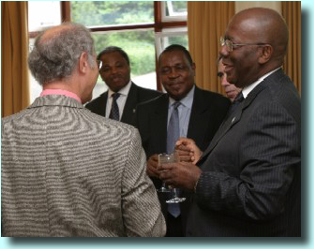
"The
UK's 'over the horizon' commitment to support
peace in Sierra Leone remains."
Bilateral
cooperation with the UK includes the following:
- "The
UK-led International Military Advisory and Training
Team (IMATT) is working to build Sierra Leone's
Armed Forces to make them effective, professional
and democratically accountable.
- The
UK has committed £120 Million over the
next three years to development projects in
Sierra Leone. Our Commitment to establishing
peace, and the holistic approach the UK applied
in Sierra Leone is widely recognised as a model
for post conflict situations.
- Under
the terms of the memorandum of understanding
signed with the UN in June 1999, the UK could
offer the UN a rapid reaction capability or
"over the horizon reserve" of up to
a brigade drawn from our pool of rapid reaction
forces. The reserve was most recently deployed
in February 2003."
While
in the UK President Kabbah paid a special visit
to his alma mater in Aberystwyth, the Welsh University
he attended in the 1950s. His Excellency the President
spent a day looking around the University of Aberystwyth
where he had studied for three years, graduating
with a degree in economics in 1959.
Professor
Derec Lloyd Morgan, Vice Chancellor and Principal
of the University welcomed President Kabbah back
to his alma mater. "The visit is a private
visit", he said.
"The
fact that Dr. Kabbah wished to see the University
at Aberystwyth once again is testimony of his
deep love of the place and of his appreciation
of the education he received here in the late
fifties."
"Few
universities have the honour of receiving former
students as State Presidents."
"Aberystwyth
is proud of its connection with Dr. Kabbah and
wishes Sierra Leone a peaceful, prosperous future,"
the Vice chancellor added.
-END-
|


