German President, Professor Dr. Horst Koehler,
with Wife, Ends Visit
By
Marian Samu
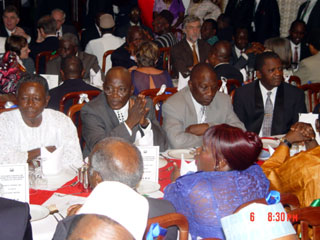
President Horst Koehler and Mrs. Eva Luise
Koehler and members of the visiting German
delegation were on Monday night, 6th December,
2004, guests of honour at a State Banquet
held in their honour at State House in Freetown.
President Kabbah while extending a warm and
hearty welcome to President Koehler and Mrs.
Koehler and the delegation, noted that the
timing of the visit of President Koehler was
particularly appropriate as Sierra Leone is
just emerging from a decade-long conflict,
especially at at a time when the country is
reaching out to friends and international
partners to assist in its reconstruction efforts
and to strengthen existing relations and build
new ones.
President
Kabbah expressed appreciation that President
Koehler chose to visit Sierra Leone on the
first leg of his African tour, describing
the visit as historic, which will not be forgotten
for a very long time to come. He underscored
the significant role Germany has played in
Sierra Leone in the areas of Trade and Economic
Cooperation, Education and Training and Infrastructure
development, dating as for back as the 1970s.
He lauded Germany's contribution to Sierra
Leone's recovery and development efforts from
the ashes of war, and their support in the
promotion of peace and security, conflict
resolution and prevention, and the promotion
of good governance and the rule of law.
He
paid special tribute to Ambassador Karl Prinz,
whom he said, exemplified the finest German
values during his tenure of office as Ambassador
in Sierra Leone, but who had to leave the
country during the military regime that preceded
his ascent to power in 1996, as the Ambassador
could not accept the flagrant abuse of democratic
principles.
President
Kabbah also expressed gratitude for the successful
projects implemented in Sierra Leone by the
German Technical Cooperation International
Services, (GTZ), particularly in the construction
of roads and bridges in the country, citing
the construction of the Congo Cross Bridge,
the Bo-Kenema highway the Masingbi-Kono, Makeni-Matotoka
and the Freetown-Waterloo highways.
The
President, however, appealed to the German
Government to do every thing in their power
to sensitize the European Union and its member-countries
about the dire need to repair dilapidated
and ruined roads as it is one of the areas
which was targeted and badly devastated by
the rebel war, including the rehabilitation
of the Lunsar-Makeni-Kabala road and the Kenema-Koindu
road in the Eastern Province, noting the great
economic importance of the Kenema-Koindu road
as it passes through the main agriculturally-productive
areas and leads to the international market
centre of Koindu, where businesspeople from
Sierra Leone, Liberia and Guinea have since
1932 being converging and carrying out commercial
transactions. President Kabbah also highlighted
the Kenema-Koindu road as the main supply
artery for border security forces along the
Sierra Leone-Liberia and Sierra Leone-Guinea
borders.
Among
other things, President Kabbah reiterated
the warm hospitality he received during his
visit to Germany in 2002, where he held fruitful
discussions with former German President Rau,
officials of the German government, development
partners, the public and private sector. He
expressed satisfaction over the reopening
of the German Embassy in Freetown, but appealed
for the appointment of a resident Ambassador
to Sierra Leone and to start consular services.
He also expressed appreciation for assistance
to the work of the Truth and Reconciliation
Commission, the disarmament, demobilization
and reintegration of ex-combatants, finacial
support to UNAMSIL and the country's food
security programme.
Highlighting
some of the progress made so far since the
end of the war and the establishment of democracy,
President Kabbah noted the establishment of
government authority throughout the country
and the successful conduct of Presidential
and Parliamentay elections in 2002 and Local
Government elections in 2004. He also informed
the visiting President of institutional reforms
like the devolution of authority to local
councils, the establishment of the Anti-Corruption
Commission, the establishment of the Law Reform
Commission to review and update the laws so
that they can be consistent with modern democratic
practices, including measures to enhance the
rule of law and empowerment of the Judiciary.
President
Kabbah was also pleased to report steady increase
in the export of the country's diamonds from
a meagre sum of US$10 million in 2000 to US$118
million by November, 2004. This, he said,
has enabled government to start earning substantial
revenue from such exports. Other issues highlighted
by President Kabbah included Sierra Leone's
effective participation in the activities
of the Ecomic Community of West African States,
and the revitalization of the Mano River Union
which comprises the immediate neighbouring
countries of Guinea, Liberia and Sierra Leone.
President
Kabbah stated that his government views the
visit to Sierra Leone as an important milestone
in the relations between the two countries
and peoples, and that it will enhance cooperation
and understanding in many areas of mutual
interest. The President of the Federal Republic
of Germany, Professor Dr. Horst Koehler, expressed
appreciation for the warm reception he and
his delegation received from their Sierra
Leonean hosts. President Koehler also expressed
delight that he is the first German President
to have visited Sierra Leone, adding that
Sierra Leone is also the first country he
has visited on his first visit outside Europe
since he became president.
President
Koehler stated that his visit to the African
continent is no coincidence, as during his
work at the IMF as Director, he became fascinated
with the beauty of the African continent,
as well as the friendly people and the immense
problems and challenges facing the continent.
He lamented over the untold suffering and
horror the war brought to countless people
in Sierra Leone, noting that many wounds are
yet to be healed.
The
German President stated that the devastating
images of war remain unforgotten in Europe
and Germany in particular, almost sixty years
after the second world war. Inspite of this,
he observed that Sierra Leone has shown that
it has the strength and courage to build a
new and bright future. The traumas endured,
President Koehler noted, have not been suppressed
by the Truth and Reconciliation Commission
and the Special Court. Sierra Leone, he said,
is striving to come to grips with this past,
and to make a new beginning.
President
Koehler also commended the exemplary way in
which the 2002 Presidential elections were
held, including the recent local government
elections, describing them as free, fair and
peaceful. He said these elections sent a clear
message to the international community and
they in Germany also clearly understood that
Sierra Leone is determined for its citizens
to participate fully in the nation's political
life.
He
particularly made reference to President Kabbah's
speech in Parliament after the elections,
which he noted, emphasized Civil Society's
involvement in shaping the country's future.
President Koehler observed that President
Kabbah showed his commitment to protecting
human rights, combating corruption and ensuring
good governance.
The
German President also lauded President Kabbah
and the people of Sierra Leone for demonstrating
that they have a clear idea of how to go about
to build a brighter future for the country.
He assured President Kabbah of their belief
in his commitment and their readiness to support
him and the people of Sierra Leone in their
reconstruction efforts. Although Sierra Leone
has achieved much, President Koehler noted,
there is still much to be done. And for this
reason, his delegation comprises business
executives, private and public members, young
people, writers etc., who all may have a contribution
to make to the development of this country.
He also made mention of efforts being made
by young people in Germany in finding ways
of assisting the young people of Sierra Leone.
He said a Vocational School in Berlin was
busy organizing a workshop to enable them
provide training for young people in Sierra
Leone. He also talked about the "Mothers
for Mothers" organization and the "Together
for Africa" who are all assiduously working
to provide help for people in Sierra Leone.
At
a reception hosted by the German President
and Mrs. Eva Luise Koehler on Tuesday night,
December 7th, to which President Kabbah was
guest of honour, President Horst Koehler expressed
that since his arrival in Sierra Leone, he
had developed new impressions about President
Kabbah and the people of Sierra Leone, particularly
the way they have succeeded in establishing
peace and the rule of law through the Truth
and Reconciliation Commission and the Special
Court. The evening, he said, is dedicated
to the friendship between Sierra Leone and
Germany, and in particular to the peoples,
noting that it is important to strengthen
the bilateral relations and ties.
President
Koehler used the occasion to award Dr Christian
Bell, a German-trained Sierra Leonean Medical
Doctor, with the honour of the "Cross
of Marriage", for his hard work in the
medical field. President
Koehler informed the gathering that the business
delegation has also donated an ultra-sound
machine to Dr Bell to assist him in his work.
The
children of Pendembu Roman Catholic Girls'
School were also singled out to receive a
donation of thirty-five thousand Euros, for
rebuilding of their school, a donation that
came from young people in Germany, who collected
the money by singing carols.
President
Prof. Dr. Horst Koehler and his delegation
left Sierra Leone on Thursday 9th December
2004. Before his departure, President Koehler
and President Kabbah exchanged fairwell courtesies
at the Bintumani Hotel and at the UNAMSIL
Helipad where President Kabbah said 'aufwiedersehen'
to his departing special guest.
President
Koehler and his delegation were accompanied
to the Lungi International airport by Vice
President, Honourable Solomon Berewa, from
where he flew to the Republic of Benin for
the second leg of his four-nation African
tour.
-End-