President
Kabbah At European Commission Headquarters
By Yusuf Alghali
Friday
16th April 2004 - President Ahmad Tejan
Kabbah has outlined what he referred to as the
"still outstanding issues that are critical
to Sierra Leone's reconstruction programme,"
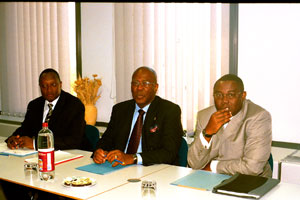
during his meeting with a group of senior officials
of the European Commission (EC) at the Commission
headquarters in Brussels, Friday 16th April
2004.
The
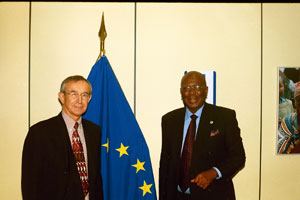
President, who was accompanied by Foreign Minister
Momodu Koroma and Ambassador Foday Daboh, told
the European Commission Head of Cabinet, Dr.
Friedrich Hamburger, about the need to promptly
address "critical areas of EU assistance
to Sierra Leone", including the country's
Post-Conflict Budgetary Support; Financial Support
to the Sierra Rutile Mines, Rehabilitation of
the Masiaka-Bo Road, Re-gravelling of the Songo-Moyamba
Junction Road as well as Maintenance of Trunk
Roads.
Already,
EC support to the proposed National Population
Census and the re-opening of the Rutile Mines
have recently been approved for funding in addition
to previous EC funding approvals for the Freetown-Conakry
Highway; the Health Sector Support Programme
and the Linking Relief, Rehabilitation and Development
Project (LRRD).
However,
President Kabbah indicated that delays in releasing
funds under the Post Conflict Budgetary Support
Programme had caused problems in the economy
and urged the commission to expedite their auditing
process so that government could have access
to outstanding funds. In this connection, the
first week of May 2004 was agreed for the team
of auditors to visit Freetown and provided that
the results are positive, funds would be released
without further delay.
On
the EC's loan support towards the resuscitation
of the Sierra Rutile Mines, the Head of State
requested a one-off payment instead of releasing
funds in two separate installments. To this
end, EC officials explained that there was flexibility
in the loan payment schedule and the timing
of the release of funds, pointing out that the
eventual frontloading of funds according to
the "urgent needs" stressed by the
President would be possible.
With
reference to the delayed road infrastructure
projects, President Kabbah stressed that the
Masiaka-Taiama-Bo road was "the most urgent"
since it is the "main arterial road"
linking the Freetown capital to the second and
third largest cities of Bo and Kenema respectively.
While appealing for the fast-tracking of this
project's implementation, the President also
said the proposed project for the construction
of 600 km of feeder roads in Kambia, Port Loko,
Pujehun and Kenema districts would also be adversely
affected if funds for the former were not released
promptly. With respect to the timetable for
the implementation of the Masiaka-Bo project,
the operational services of the commission gave
further details. "Providing that the tendering
documents are elaborated quickly, an initial
estimate is that at least six to eight months
will be needed before the construction works
can start," the EC's Transport Infrastructure
expert Manuel Puerta told the meeting. However,
Sierra Leone's Minister of Foreign Affairs and
International Cooperation Momodu Koroma, in
his intervention, stressed the significance
of the local climate conditions and the fact
that for best road construction results, work
should start by October 2004.
President
Kabbah, who also looked forward to reaching
a fisheries agreement with the European Commission,
expressed concern over the continuing widespread
illegal fishing by foreign vessels in the country's
territorial waters, depriving Sierra Leoneans
of both an essential diet and national income.
He said the proper management of marine resources
was very crucial to the realization of his declared
national food security by 2007.
Meanwhile, the EC will dispatch a mission to
Freetown in May to embark on a programme to
improve the quality of local fish products and
make them eligible for export to EU member countries
and the President has welcomed the EC's inclusion
of Sierra Leone in a sub regional project expected
to manage and monitor fish stocks in the sub
region.
Other
issues raised and discussed by the President
and delegation relate to capacity building for
the National Authorising Office (NAO), Ministries,
Departments, Agencies, and Non-Governmental
Organisations, Civil Society and the Private
Sector, to which EC officials indicated their
continued interest and support. The support
and capacity building of civil society at district
level, it was noted, would be carried out in
coordination with actions supporting the decentralization
process in Sierra Leone.
The
Commission congratulated the President for his
efforts in the democratization of the country
and the stabilisation of the region and assured
the President that "the special post conflict
situation of Sierra Leone" will be taken
into consideration in the European Commission's
cooperation with the country.
For
his part, the President concluded by saying
that the best way his government could express
gratitude to its European Union partners was
to "do the right thing".
-End-


