The
NCDDR was established in July of 1998 to give
sharper focus to the critical issue of combatants,
whose numbers and factions increased significantly
following the interregnum created by the AFRC
coup d'etat of May 1997. The committees' membership
comprised government representatives, peacekeepers,
donors and the factions to the conflict -
Revolutionary United Front, Armed Forces Revolutionary
Council and Civil Defence Force.
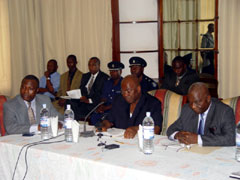
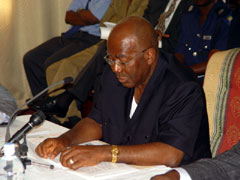
Speaking as he chaired the last meeting of
the Committee at State House today 3rd February
2004, President Kabbah said the meeting had
been convened to consider the report of the
Executive Secretary Dr. Francis Kaikai on
the DDR process, acknowledge all key players
in the peace process and their contribution
to the country's DDR Programme and agree on
the next steps.
The
President recalled his administration's earlier
two-pronged approach to address the problems
posed by combatants through a special programme
supervised by NCDDR and the problems of internally
displaced persons, refugees and other war
affected populations supervised by the National
Commission for Resettlement, Rehabilitation
and Reconstruction (NCRRR), now NaCSA.
He
stressed that completion of the reintegration
programme for ex-combatants had been one important
benchmark for the consolidation of the peace
since he declared the end of the war in January
2002, noting his pleasure that this had now
been achieved.
According
to NCDDR Executive Secretary Dr. Kaikai, more
than 50,000 of the 56,700 ex-combatants who
registered for support with the NCDDR-Executive
Secretariat had already been provided opportunities
in the Western Area and all Districts of the
country. In addition he said modalities were
already in place to address the few remaining
ex-combatants in the next four weeks leading
to the conclusion of the committees' task.
"This
is remarkable progress and an important contribution
to our country's recovery," President
Kabbah said, thanking Dr. Francis Kai-Kai
and his team for having accomplished what
many thought was an impossible task. He went
on to praise their unflinching show of discipline,
commitment, hard work and exceptional dedication.
"For this, the people of this country
owe you an immeasurable debt of gratitude,"
he added.
Touching
on the next steps, the Head of State indicated
that national reintegration, to which NCDDR
had significantly contributed, would be further
promoted by other institutions that were already
established and functioning for all members
of our various communities including ex-fighters
who had gone through the DDR programme. He
said the Ministry of Youths and Sports and
the National Commission for Social Action
(NaCSA) were being supported by a host of
other government and non-governmental agencies
that are involved in development work at community
level.
He
thanked all those who he said had made immense
contributions to Sierra Leone's difficult
peace process, mentioning in particular the
United Kingdom, Japan, Germany, Netherlands,
Sweden, Denmark, Norway, Switzerland, Italy,
USA, Canada, The European Union, The World
Bank, for not only their support through the
Community Rehabilitation and Reintegration
Programme, but also for their technical support
to Government and for the administration of
the Multi-Donor Trust Fund. He also singled
out the peacekeepers over the period, including
ECOMOG, UNOMSIL in 1998 and later UNAMSIL,
whose presence all over the country, he said,
provided the right environment for progress
and eventual success.
The
President also had words of appreciation for
the civil society and all its constituent
members (Inter-Religious Council, Civil Society
Movement, the print and electronic media etc)
and above all, the ordinary people of Sierra
Leone including the youths who he noted "exercised
extraordinary patience and understanding".Other
speakers at the event included British Envoy
Dr. John Mitchiner, who spoke on behalf of
the donor community and Mr. Alan Doss, who
deputised the new UN SRSG Mr. Mwakawago.
-End-


