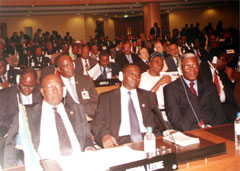
President
Kabbah Returns From African Union Summit
The
President, Alhaji Dr Ahmad Tejan Kabbah, returned
to Freetown Thursday 8th July, 2003 from the
Ethiopian capital, Addis Ababa, where he attended
the Third Ordinary session of The Assembly Of
the African Union.
The
President was among over fifty heads of State,
their representatives and heads of bilateral
and multilateral organisations who graced this
year's summit.
President Joaquin Chissano of the Republic of
Mozambique, Chairperson of the 2nd Ordinary
session of the Assembly of the African Union
in his statement paid tribute to African Leaders
for establishing the African Union and strengthening
it with new organs such as the Pan-African Parliament,
the Peace and Security Council and the Economic,
Social and Cultural Council.
He
welcomed the consolidation of peace in Sierra
Leone, demonstrated in the conduct of free,
fair and peaceful democratic elections in the
country and other recent political developments
such as the holding of countrywide local government
elections.
He
noted that conflict situations still prevailed
in parts of the Continent, adding that they
constituted major obstacles to development and
reiterated the need for Member States to contribute
to the Peace fund.
The
Chairperson of the Commission of the African
Union, President Alpha Omar Konare, recounted
successes recorded in managing conflicts on
the Continent and in particular, called on Member
States to support the Sudanese Government and
the opposition to restore peace and security
in Darfur.
He
said the time has come for Africa to convince
itself that it must go beyond poverty and produce
wealth. But to change this strategy, he said,
means drawing inspiration from the brilliant
victories of our peoples in the great battles
of the last century against colonisation and
apartheid and also implementing a strategy of
visibility, self-assertion and responsibility,
which would require, as in the times past, strong
unity. In this regard he said there was need
to forge unfailing solidarity and to make a
lot of sacrifice, and build new alliances with
the peoples and governments of the world.
He spoke of the need to explore new ways of
mobilising resources such as taxation and international
financial transactions and taxation on arms
sale.
Prof.
Konare later presented the Union's strategic
vision, which outlined strategies and programmes
the union plans to undertake which would eventually
lead to a One-Africa. Though some thought the
vision was too ambitious, especially regarding
the financial implications, many believed that
with commitment it could be achievable.
The
Secretary General of the United Nations, Mr.
Kofi Annan, on his part, commended African Leaders
for the role they played in stabilizing Liberia,
Burundi and the Comoros, and their determination
to bring about peace and security on the Continent.
He
welcomed the establishment of the Peace and
Security Council as a landmark effort for which
the United Nations would continue to assist
with information, training, expertise and resources
so as to accelerate the process of putting in
place the African Standby Force. He was, however,
concerned about the persistence of deadly conflicts
in Africa with particular reference to the situation
in Darfur, in Western Sudan.
Mr
Annan said the United Nations would fully support
the African Union's efforts to address the root
causes of the conflict to achieve a political
settlement but was also greatly concerned by
the recent upsurge in violence in eastern Democratic
Republic of Congo and the continued instability
in Cote d'Ivoire, and by the continued tension
between Ethiopia and Eritrea. He spoke of the
need for all to work together to fight poverty,
disease, ignorance and lack of life-sustaining
services which afflict the lives of millions
every day.
The
UN Secretary-General described the Peer Review
Mechanism as a uniquely African approach to
the challenges of African governance but that
its promise will only be realized with the political
will to make the mechanism work, as a tool to
strengthen democratic governance throughout
Africa.
Mr
Annan was pleased to note that today, more African
states have democratically-elected governments
than ever before and that in many African countries,
like Sierra Leone, new governments have come
to power in multi-party elections with voters
turning out in large numbers, reflecting their
commitment to exercising their rights as citizens.
He
pointed out that there "is no truer wisdom,
and no clearer mark of statesmanship, than knowing
when to pass the torch to a new generation"'
and called on all to remember that constitutions
are for the long term benefit of society, not
the short term goals of the ruler.
"Democracy is not perfect, and democratisation
is not easy. But the more accountable governments
are, the more likely they are to be responsive
to the needs of their people-whether that need
is to prevent famine, fight poverty, or halt
the spread of HIV/AIDS, Mr Annan told the gathering
of African leaders.
He
gave the assurance that the UN would support
efforts to build the institutions of accountability
and participation in each country and in the
African Union itself, and would spare no effort
to ensure that development partners keep their
solemn promises-including those they made in
the Millennium Declaration on trade, debt relief,
and overseas development assistance.
Nigeria's
President Olusegun Obasanjo was, after consultation
by ambassadors of the AU, unanimously elected
chairman of the assembly, with fourteen Vice
Chairmen from different regions of the continent.
In receiving the symbol of authority from outgoing
chairman, President Chissano of Mozambique,
President Obasanjo said Nigeria was highly honoured
to be given the chair of the assembly and promised
to discharge his duties with utmost commitment
and diligence.
He said Nigeria would strive at all times to
promote unity and solidarity and Africa's independence,
and solicited the support of member countries
to promote sustainable development. He said
political stability and peace are necessary
conditions for socio-economic development. He
said therefore that they must strive to address
conflicts in the region. President Obasanjo
also promised to work to strengthen Africa's
relationship with the rest of the world.
He
thanked the government of Mozambique for its
sustained interest in the Union and paid tribute
to President Alpha Konare for the able manner
he had been conducting the affairs of the commission,
describing him as a visionary leader.
-End-