|
President
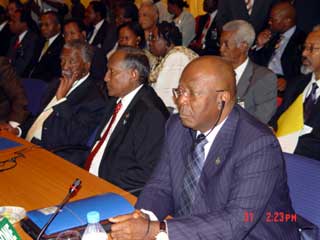
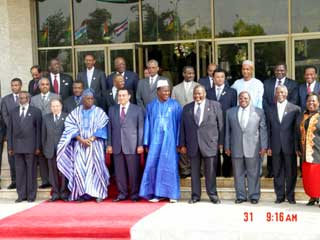
Kabbah Returns From African Union Summit
By Marian Samu
The
President, Alhaji Dr. Ahmad Tejan Kabbah, has
returned to Freetown after attending the African
Union summit in Abuja Nigeria, from the 30th-31st
January, 2005.
Delivering
his statement at the official opening ceremony
of the Fourth Ordinary Session of the Assembly
of Heads of State and Government of the African
Union, His Excellency Olusegun Obasanjo, President
of the Federal Republic of Nigeria and Chairman
of the African Union said, the decision to have
a Mid-term session which was adopted at the July
2004 meeting was to primarily have another opportunity
to review the implementation of the decisions
and declarations adopted at the July meetings,
as well as to keep track of the various conflict
situations on the continent. He, however, stated
that developments since July 2004 have made it
even more imperative to meet around this period,
to address certain issues of immediate importance
and concern to us in Africa.
President
Obasanjo cited the renewed escalation of the crisis
in Cote d'Ivoire and the situation between the
Democratic Republic of Congo and Rwanda, which
he said, was threatening the stability of their
regions.
On
the other hand, he said, there have been some
cheering developments especially in respect of
the long-standing North-South conflict in the
Sudan. He said that the comprehensive Peace Agreement
signed in Nairobi on January 9, 2005 provides
a basis for a solution to that conflict and if
adopted can also help in resolving other conflicts
in the Sudan.
President
Obasanjo highlighted the issues of food security,
HIV/AIDS, malaria, tuberculosis and other infectious
diseases as still deserving urgent attention although
they have been dealt with at the previous sessions
in the recent past. He appealed to the Heads of
State to identify the new dimensions that have
not been adequately addressed in the existing
decisions and declarations and which are capable
of facilitating effective implementation and result-oriented
plans of action.
Speaking
on his promise made after his election as Chairman
of the African Union, to visit some countries
on behalf of the AU to both introduce the organization,
outline priorities, explain what NEPAD is, and
seek support for on-going and future projects,
President Obasanjo reported that his visits to
countries like the United States, the UK, Japan,
India, and Sweden have been very fruitful. He
reported that the appreciation of the new position
and role of the AU as well as of NEPAD is increasing.
The atmosphere in the global community, he said,
is clearly more conducive, more responsive, and
more sympathetic. This disposition of the global
community towards Africa today, he noted, provides
a better opportunity to obtain more support and
resources from friends and development partners.
He therefore appealed to all to sit, think and
plan together to exploit the changing and conducive
atmosphere in the global community.
"To
do this, we must continue on the path of sustainable
socio-economic and political reforms. We must
address in a more determined manner the issue
of conflict....We must do all we can to deepen,
widen and sustain democratic practice, values
and institutions" he emphasized.
Addressing
the session also, President Alpha Oumar Konare,
Chairman of the Commission of the African Union,
among other things, expressed the need for the
meeting to focus on the security situation in
the continent. He said that if the security situation
of the continent does not improve, there can be
no development. He spoke about the need to improve
the way defence mechanisms work, to enable the
deployment of troops more rapidly and to mobilize
respective national forces in the service of African
causes, alongside regional mechanisms. He also
strongly advised partners to "dismantle their
network of mercenaries", and emphasized the
need to clamp down on merceniarism.
The
summit, he said, could also point us in the right
direction as we prepare Africa's contribution
to the debate on the status of the Millennium
Programme. He warned that if we do not assume
greater responsibility in the implementation of
this Programme and if new resources are not mobilized,
the goals set for 2015 will not be attained in
the next century.
On
the issue of debt reduction, President Konare
advised African leaders to ensure that we avoid
falling into the trap of conditionalities, and
that we prevent the exclusion of some African
countries from the debt reduction initiative.
He urged them to remember that the total debt
cancellation and the doubling of Official Development
Assistance will not provide a lasting and comprehensive
solution to the problem of financing our development;
as we need a critical mass of resources to pursue
our development objectives.
The
United Nations Secretary-General, Mr. Kofi Annan,
although he stated in his address that Africa
has a disproportionate share of the world's poor,
lags behind other parts of the developing world
in achieving the Millennium Development Goals,
and continues to suffer from the tragic consequences
of deadly conflict and poor governance, praised
the African Union for working very hard to advance
the goals of NEPAD. He said that in a very short
period of time also the AU has made great strides
in promoting conflict management in Africa. Nowhere
is this more evident than in Sudan's Darfur region,
where AU forces have deployed in a very challenging
environment and are making an important contribution.
This,
he said, is a crucial effort, and the United Nations
will continue to offer both political and practical
support for it. He also stated that the signing
of the Comprehensive Peace Agreement on Sudan
earlier in January was a great success for African
mediation efforts and offered hopes that all regions
of the country can achieve peace, stability and
development.
The
landmark issues discussed at the summit include
the African Union representation in the United
Nations Security Council, which will be further
determined at a meeting in Swaziland, security
concerns of the African sub-region , Food Security,
and the prevention, treatment, and elimination
of the endemic diseases: Malaria, Tuberculosis,
Polio and HIV/AIDS.
At
the end of the meetings, President Kabbah paid
a visit to the new Sierra Leone High Commission
Office in Abuja where he met with the High Commission's
staff and a cross-section of the Sierra Leonean
community in Nigeria.
-END-
|