Anti-Corruption
Commission Presents Five-Year Strategic Plan
The
Director of Prevention and Sensitisation in
the Anti-Corruption Commission (ACC), Mrs. Neneh
Daboh, has officially presented copies of the
ACC's five-year Strategic Plan to President
Ahmad Tejan Kabbah at a brief ceremony held
at the Hill Station Lodge Monday 12 January,
2004.
According
to the ACC's Commissioner, Val Collier, the
conclusion of the first phase of support to
the Anti Corruption Commission in early 2003,
saw the need for a review of the general development
of the Commission, an assignment undertaken
jointly by the Government of Sierra Leone, ACC
and the British Department for International
Development (DFID). The process which commenced
in November 2002 embodied a range of recommendations
about the immediate development of the commission
and the need for the preparation of a Strategic
Plan to guide the commission's future growth
and operations.
Mr.
Collier indicated that the existence of the
Strategic Plan and the general state of progress
in anti-corruption activity in Sierra Leone
made it opportune for DFID to design a second
phase of institutional capacity development
and support for the commission and possibly
for wider coverage and developments in anti-corruption
work in the country involving the Anti-Corruption
Commission Coalition and a National Anti-Corruption
Strategy. He was delighted to note that that
exercise had now been satisfactorily completed
through extensive cooperation between the ACC
and DFID.
The
Strategic Plan presented, in the words of Mr.
Collier is "our collective attempt to formulate
a forward-looking strategy for the organization
of the ACC in order for it to meet the socio-economic
and political challenges posed by the current
times and to identify and determine the role
that it will play in partnership with other
national institutions in combating corruption".
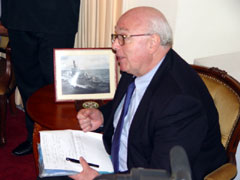
Commissioner
Collier quoted President Kabbah, who once said:
"Corruption is a vicious enemy of our society…
If this country is to develop, the culture of
impunity that has become so entrenched in our
society must be made a thing of the past. Corruption
has to be eliminated." He said the ACC
continued to remain heartened by "that
very bold and decisive assertion", which
had served as a morale booster in their continuing
campaign against corruption and impunity. "We
are also heartened by Your Excellency's personal
commitment to the cause of fighting corruption
at all levels of our society, both in the public
and private sectors, bearing uppermost in mind
the need to steadfastly maintain a zero tolerance
for corruption," Collier said, in a statement
preceding the presentation.
Receiving the documents, President Kabbah expressed
gratitude to the British Government for their
support in setting up his brainchild - the Anti
Corruption Commission. He observed that the
setting up of any oversight institution such
as the ACC was not an easy job, pointing to
the numerous roadblocks usually encountered
in the process. In this regard, he congratulated
both the foreign donors and local managers who
had worked hard in surmounting difficult obstacles.
He
further observed that in the past, it was taboo
to mention the word 'corruption', whereas today
everybody, including school children, clergymen,
public officials talks about its negative impact
on the country's developmental aspirations.
"That awareness in itself is an achievement,"
the Head of State said, adding that musicians
have also joined the bandwagon in sending anti-corruption
messages across.
He
promised to carefully study the documents, for
as he put it, he would like it to be one of
the most useful legacies he would be leaving
behind at the end of his current and final term
in office. He thus appealed for all to maintain
the present level of interest shown "so
that at the end of the road we all could look
back and say 'yes we have achieved something".
-End-


