Anti
Corruption Commission Presents Second Annual
Report
by Yusuf Alghali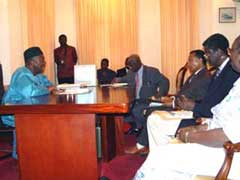
President
Ahmad Tejan Kabbah has registered his strong
disappointment over the apparent slow progress
and lack of tangible results in both the investigation
and prosecution of corruption-related offences.
Speaking
during Commissioner Val Collier's formal presentation
of the second annual report of the Anti-Corruption
Commission (ACC) at the Lodge Thursday 14th
August, the President said he had often been
embarrassed while abroad by persistent questions
pertaining to the huge backlog of corruption
cases still awaiting investigation and or prosecution.
He
confessed that he had been running out of excuses,
trying to explain - for example - the current
fate of Mr. Momoh Pujeh's alleged corruption,
as well as other outstanding matters involving
former high court judge Taju Deen and ex-cabinet
minister Dr. Harry Will.
President
Kabbah further indicated how saddened he was
by the fact that no action had yet been taken
on dozens of other corruption cases, which the
Anti-Corruption Commission had reportedly referred
to the Attorney General's Office for prosecution.
He said such a situation was difficult to justify,
calling for the prompt replacement of magistrates
who might be responsible for stalling trials.
"Donors are watching…and our people
are very critical," the Head of State said,
adding: "We have to show that we are serious
and committed."
He also made it clear that his government did
not wish to interfere with the day to day running
of the ACC's affairs, but stressed that public
complaints about lack of results keep cropping
up. He said delays in investigating corruption
allegations would cause sceptics to think that
the ACC was covering up something because of
certain considerations.
Last
Month, Chief Justice Abdulai Timbo and another
legal representative traveled to London with
the aim of interviewing Commonwealth judges
and prosecutors who would aid the ACC's activities
in Sierra Leone. However, the President noted
with regrets that one of the prosecutors withdrew
his application shortly after being interviewed,
probably as a result of some unsavoury characterisation
of the war against corruption.
He
said even though the ACC was an independent
institution, they must always channel their
institutional constraints to government, a fact
buttressed by Vice President Berewa, who emphasised
that government had an obligation to support
the work of the commission nationwide.
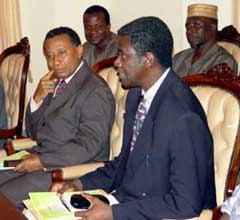
The
Vice President also went on to stress that there
should be greater collaboration between the
ACC and government rather than competition,
pointing out that donors had always impressed
on the Sierra Leone government the need to tackle
corruption as a most critical benchmark for
assistance. 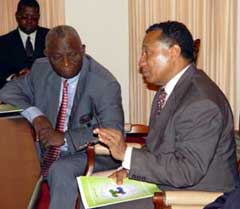
But
the President was full of praises for the good
work being undertaken by the Prevention section
of the ACC, headed by Mrs. Neneh Daboh, thus
singling out Mr. James Kanyako's investigations
division and the Attorney General's office for
the severest of criticisms.
In
his defence, however, the Director of Investigations
complained about lack of adequate personnel
to investigate the series of allegations earlier
brought before it. As of now, he argued, investigators
are overloaded with some handling as much as
thirteen cases each. He said if this trend could
be reduced to five or six cases per investigator,
the situation could improve dramatically.
In
addition, Mr. Kanyako disclosed that some old
investigators, who had been replaced by new
ones, had over a hundred cases among them, noting
that new ones were currently faced with the
task of re-starting investigative procedures
all over again.
For
his part, Attorney General Eke Halloway blamed
the delays on missing files and lack of detailed
investigative reportsfrom
the ACC, although he disclosed that some twelve
cases were already in court for trials. He also
said some cases at the Attorney General's office
were not corruption-related offences as described
by the Act itself.
In
his statements, Commissioner Collier observed
that many people might think that the ACC itself
was responsible for the lack of positive results.
He said he had earlier proposed some 26 amendments
in the present Anti-Corruption Act so as to
fine-tune the ACC's operations.
Concluding,
President Kabbah urged for the Vice President,
the Attorney General, the Inspector General
of Police and Commissioner Collier to sit together
and reconcile all the differences and odds responsible
for the snail's pace movement in the ACC's activities
latest next week. He opined that many people
continue to feel cheated and bitter by the display
of fabulous wealth on the part of some top government
officials, stressing that Sierra Leoneans must
guard against these seeds of troublemaking to
avoid another round of rebel war in the country.
-End-


